
When Your AC Compressor Failed: What It Means and What to Do Next
An ac compressor failure is one of the most serious and costly problems your home cooling system can face, especially during a scorching North Dallas summer.
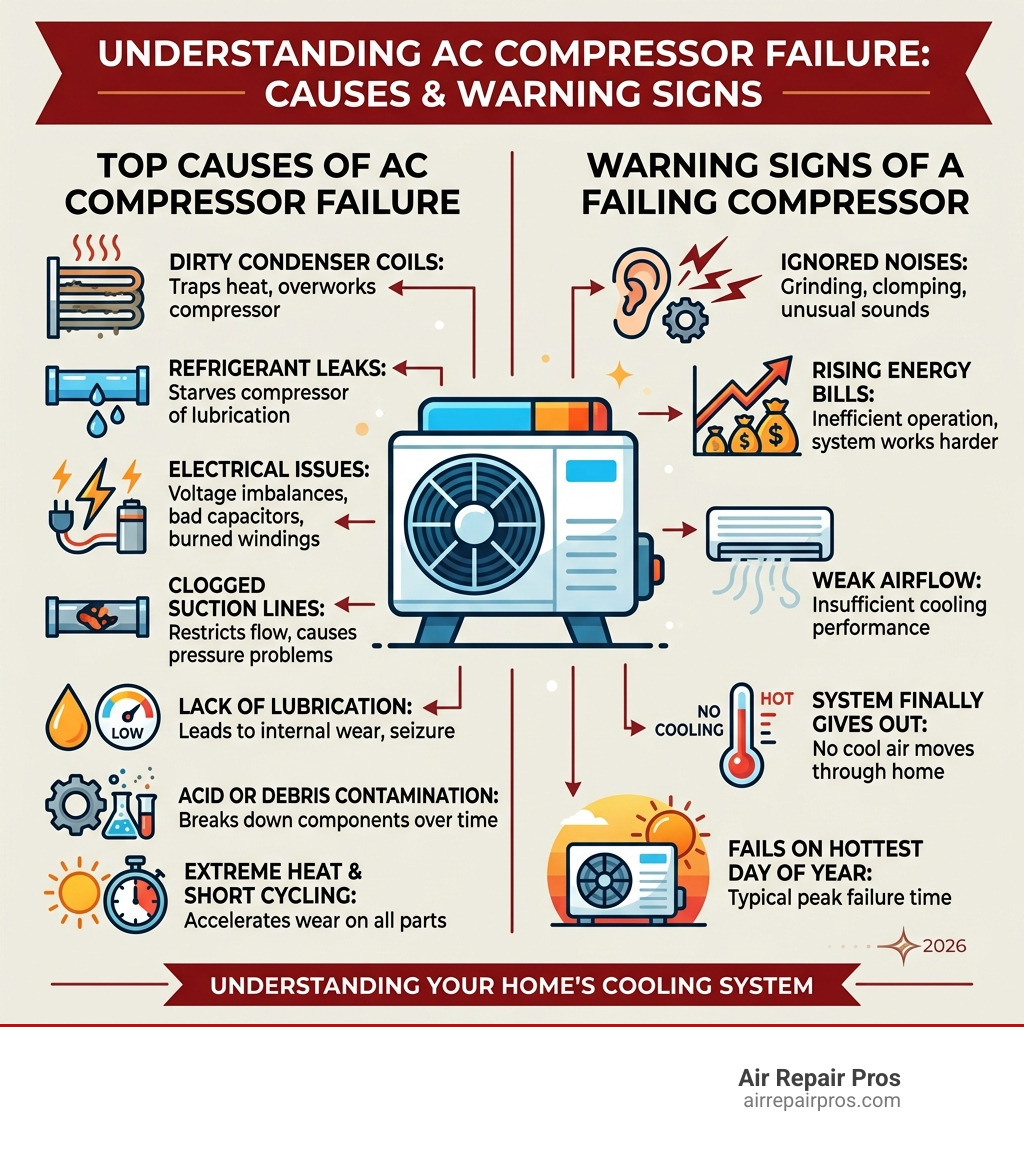
Here are the most common reasons an AC compressor fails:
- Dirty condenser coils – trap heat and force the compressor to overwork
- Refrigerant leaks – starve the compressor of the lubrication it needs to survive
- Electrical issues – voltage imbalances and bad capacitors burn out motor windings
- Clogged suction lines – restrict refrigerant flow and cause pressure problems
- Lack of lubrication – leads to internal wear and eventual seizure
- Acid or debris contamination – breaks down internal components over time
- Extreme heat and short cycling – accelerates wear on every moving part
Most compressor failures do not happen all at once. They build over time through ignored noises, higher energy bills, and weaker airflow until the system finally breaks down, often on the hottest day of the year.
Think of the compressor as the engine of your AC. Without it running properly, no cool air moves through your home at all. And unlike a dirty filter or a tripped breaker, a failed compressor is not a quick fix.
When an AC compressor fails, the whole cooling process breaks down fast, often leaving your home hot when you need relief most. In the sections below, we’ll explain the most common reasons compressors fail and what steps make the most sense next.
The Role of the Heart: What Happens When Your AC Compressor Failed
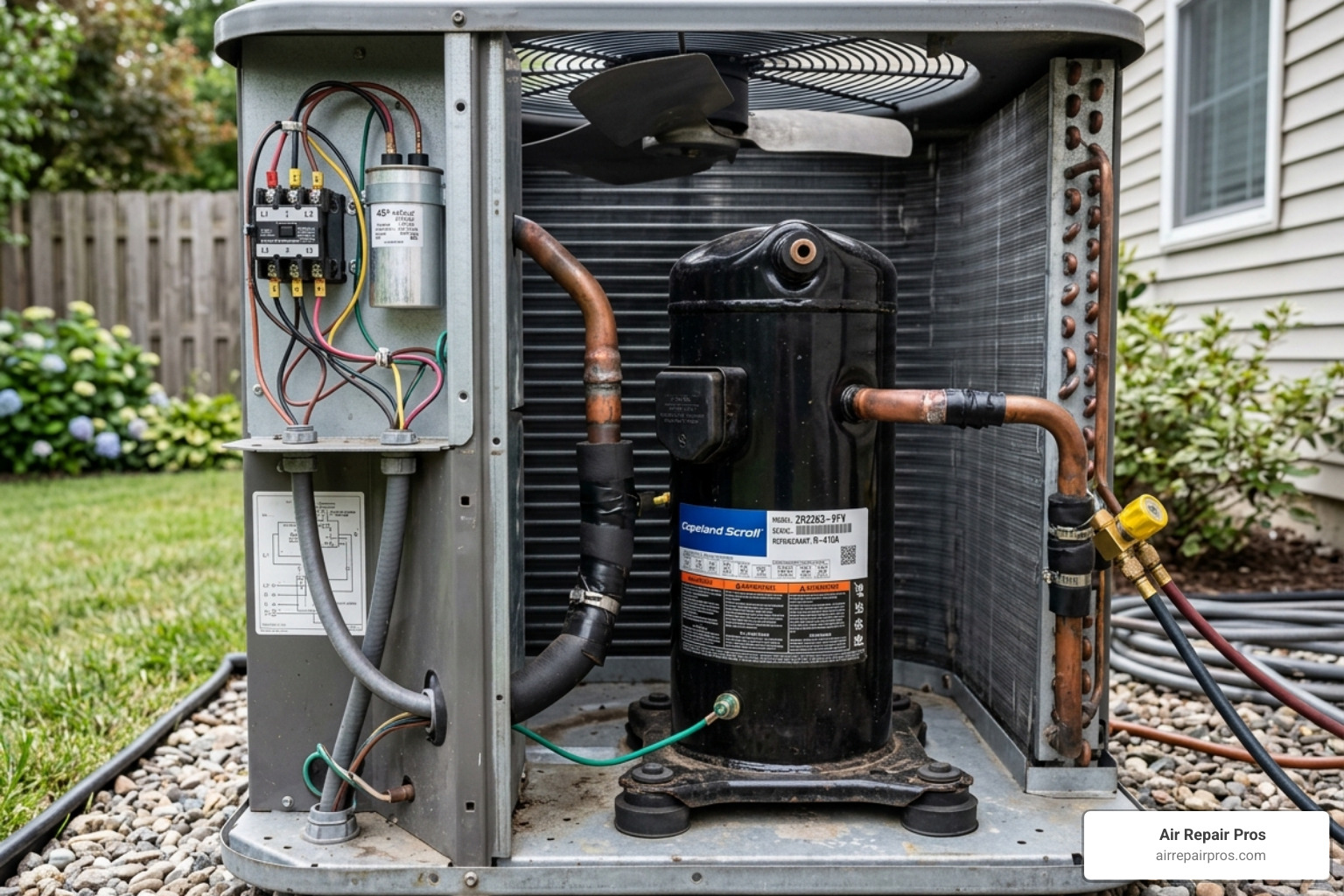
To understand why your system stopped working, we first need to look at what the compressor actually does. In the HVAC world, we often call the compressor the “heart” of the system. Just as your heart pumps blood to keep your body functioning, the compressor pumps refrigerant through the entire cooling loop.
Located in the outdoor unit, the compressor’s job is to take low-pressure, cool refrigerant gas from your indoor evaporator coil and squeeze it into a high-pressure, high-temperature gas. This compression process is vital because it allows the refrigerant to release the heat it gathered from inside your home into the outside air.
Without this “squeeze,” the heat transfer process stops. If your AC compressor failed, refrigerant no longer moves the way it should through the copper lines. Your indoor fan may still run, and your thermostat may still show “Cool On,” but the air from your vents will often feel warm or just not cold enough. You can learn more about these specific signs of a failing air conditioning compressor to compare them with what your system is doing now.
Identifying Why Your AC Compressor Failed Early
Most compressors don’t die a “sudden death.” Failing AC compressors usually send out a few SOS signals before they give up the ghost. If you catch these early, we might be able to save the unit before the damage becomes terminal.
- Warm Air from Vents: This is the most obvious sign. If the compressor isn’t pressurizing the refrigerant, the system can’t remove heat.
- Loud or Strange Noises: Listen for grinding sounds (often indicating worn-out bearings), rattling (which could be a loose mounting or internal part), or a loud “thunk” when the unit tries to start.
- Clicking Sounds: If you hear a rapid clicking when the outdoor unit tries to kick on, it’s often the electrical relay or capacitor struggling to give the compressor the “kick” it needs to start.
- Weak Airflow: While often a duct or blower issue, a struggling compressor can lead to inconsistent pressures that mimic symptoms of a bad AC compressor in a car, such as reduced cooling capacity.
Electrical Red Flags and Breaker Trips
Electrical issues are the “silent killers” of the HVAC world. Your compressor relies on a steady, high-voltage supply of electricity to run its motor. When something goes wrong with that supply, the results are often catastrophic.
One of the biggest red flags is a circuit breaker that keeps tripping. If your AC trips the breaker, do not just flip it back on and keep going. A failing compressor often experiences a “hard start,” where it pulls significantly more electricity than it’s designed to handle. This overcurrent is what trips the breaker to prevent a fire.
Common electrical culprits include:
- Capacitor Failure: This small part provides the initial electrical “jolt” to start the motor. If it weakens, the compressor overheats when trying to start.
- Voltage Imbalance: Even a small imbalance of 3-4% in your home’s voltage can cause the motor windings inside the compressor to overheat and burn out.
- Burnt Wiring: Over time, heat and vibration can fray wires or damage the electrical relay, leading to an air conditioner AC compressor failure that could have been avoided with a simple wire repair.
when
The Autopsy: Common Causes of Compressor Death
When we perform a “compressor autopsy” in the field, we usually find that the compressor didn’t fail because of a manufacturing defect. Instead, it was killed by an outside force. Here is a breakdown of the most common causes we see in North Dallas.
| Cause | Type of Failure | Result |
|---|---|---|
| Dirty Coils | Mechanical/Thermal | Overheating and high pressure |
| Refrigerant Leaks | Mechanical | Loss of lubrication and seizure |
| Voltage Spikes | Electrical | Burnt motor windings |
| Acid Contamination | Chemical | Internal corrosion and “sludge” |
| Slugging | Mechanical | Liquid refrigerant breaking internal valves |
Dirty Condenser Coils In places like Frisco and McKinney, dust, pollen, and lawn debris can quickly coat your outdoor unit. When the coils are dirty, the heat can’t escape. This causes the pressure inside the compressor to skyrocket, forcing it to work twice as hard to do the same job. Eventually, it simply overheats and dies.
Refrigerant Leaks and Lubrication Refrigerant doesn’t just cool your home; it also carries the oil that lubricates the compressor’s moving parts. If you have a leak, you aren’t just losing cooling power—you’re losing lubrication. Running a compressor with low refrigerant is like running your car engine without oil. It will seize up, and once that happens, it’s game over.
Slugging and Acid “Slugging” occurs when liquid refrigerant enters the compressor (which is only designed to handle gas). Liquids don’t compress, so they act like a hammer inside the unit, shattering valves. Additionally, if moisture enters the system through a leak, it can mix with the oil to create acid. This acid eats away at the motor windings from the inside out.
Financial Triage: Repairing vs. Replacing a Failed Unit
Once we’ve confirmed your AC compressor failed, the big question is: do you fix it or replace the whole thing? This is where “financial triage” comes in.
A compressor is often one of the costliest parts of an AC system to deal with. Repair or replacement bills can climb quickly because the job usually involves not just the compressor itself, but also specialized labor, refrigerant handling, system cleanup, and other materials needed to get the unit running safely again.
When an AC Compressor Failed Beyond Repair
There are several scenarios where we will almost always recommend replacing the entire outdoor unit (or the whole system) rather than just the compressor:
- The 50% Rule: If the cost of the repair is more than 50% of the value of a new system, replacement is usually the smarter financial move.
- System Age: Most AC units in North Dallas last 10-15 years. If your unit is 12 years old and the compressor dies, putting $2,000 into it is a gamble. Other parts, like the fan motor or the indoor coil, are likely to fail soon anyway.
- R-22 Refrigerant: If your system uses the old R-22 (Freon), it is obsolete. Repairing these units is becoming nearly impossible and incredibly expensive because the refrigerant itself is no longer manufactured.
- Warranty Coverage: If your system is under 10 years old, the compressor might still be covered by a manufacturer’s part warranty. In this case, you only pay for labor and refrigerant, making the repair much more attractive.
the
Estimated Costs for Professional Intervention
When you get a quote for a compressor replacement, you aren’t just paying for the “can” sitting in the unit. A professional replacement involves:
- The Part: The compressor itself.
- Labor: Usually 4 to 8 hours of highly technical work.
- System Flush: To remove any acid or debris from the old failed unit so it doesn’t kill the new one.
- Filter Drier: A mandatory replacement part that catches moisture and debris.
- Refrigerant Recharge: A full “charge” of new refrigerant (which can cost hundreds of dollars on its own).
Prevention: How to Keep the Heart Beating
The good news is that most compressor failures are preventable. You don’t have to be an HVAC expert to keep your system healthy; you just need to be consistent.
1. Keep it Clean The simplest thing you can do is keep the area around your outdoor unit clear. Trim back bushes at least two feet and use a garden hose (gentle pressure only!) to rinse off dust and dirt from the coils once a month during the summer.
2. Change Your Filters A dirty air filter restricts airflow. When air can’t move over the indoor coils, the refrigerant doesn’t evaporate properly, which can lead to “slugging” (liquid refrigerant hitting the compressor). Change your filters every 30 to 90 days.
3. Schedule Annual Maintenance This is the “insurance policy” for your compressor. During a professional tune-up, we check the refrigerant levels, test the capacitors, and tighten electrical connections. Catching a $200 capacitor issue today prevents a $2,000 compressor failure tomorrow.
Seasonal Maintenance Checklist:
- [ ] Clear debris (leaves, twigs) from the outdoor unit.
- [ ] Inspect the “service disconnect” for signs of melting or charred wires.
- [ ] Listen for new or unusual vibrations.
- [ ] Check that the condensate drain line is flowing freely.
- [ ] Ensure the thermostat is calibrated and not “short cycling” the system.
Frequently Asked Questions about Compressor Failure
How long does an AC compressor usually last?
In our North Dallas service area (Frisco, Plano, Little Elm), a well-maintained compressor typically lasts 10 to 15 years. Because of our extreme summer heat, units here work harder than those in the north. Without regular maintenance, that lifespan can drop to as little as 7 or 8 years.
Can I run my AC if the compressor is making noise?
We strongly advise against it. If you hear grinding or loud banging, turn the system off at the thermostat immediately. Running a failing compressor can cause it to “burn out,” releasing acid into the lines that can ruin the rest of your system. It can also lead to electrical shorts or even small electrical fires in the unit’s wiring.
Is it better to replace the compressor or the whole unit?
If your system is under 10 years old and under warranty, replacing the compressor is often worth it. However, if the system is older or uses R-22 refrigerant, replacing the entire outdoor unit (the condenser) or the full system is usually better. New systems are significantly more energy-efficient, often paying for themselves in lower monthly bills over time. Plus, a new system comes with a fresh 10-year warranty, giving you peace of mind.
Conclusion
At Air Repair Pros, we know that hearing your ac compressor failed is never news you want to receive. It’s a major disruption to your comfort and your budget. That’s why we’ve spent since 1998 building a team of certified technicians who are experts at diagnosing these issues accurately the first time.
We serve Frisco, Addison, Flower Mound, and the surrounding North Dallas communities with fully stocked trucks, meaning we can often get your cooling back up and running in a single visit. Whether you need a simple capacitor replacement to prevent a failure or a full system upgrade, we are here 24/7 for your emergencies.
Don’t let a “heart attack” in your AC system leave you sweltering. More info about AC compressor issues is just a click away, or you can contact our HVAC specialists today to schedule a professional inspection and keep your home’s heart beating strong.