

Heat Pump Not Heating in North Dallas, TX? Start With These Checks
If your heat pump is running continuously but failing to warm your living space during a cold snap in Dallas, TX, starting with several baseline evaluations can save you time and prevent unnecessary strain on your HVAC system. Before reaching for the phone to request service, complete these three essential homeowner checks:
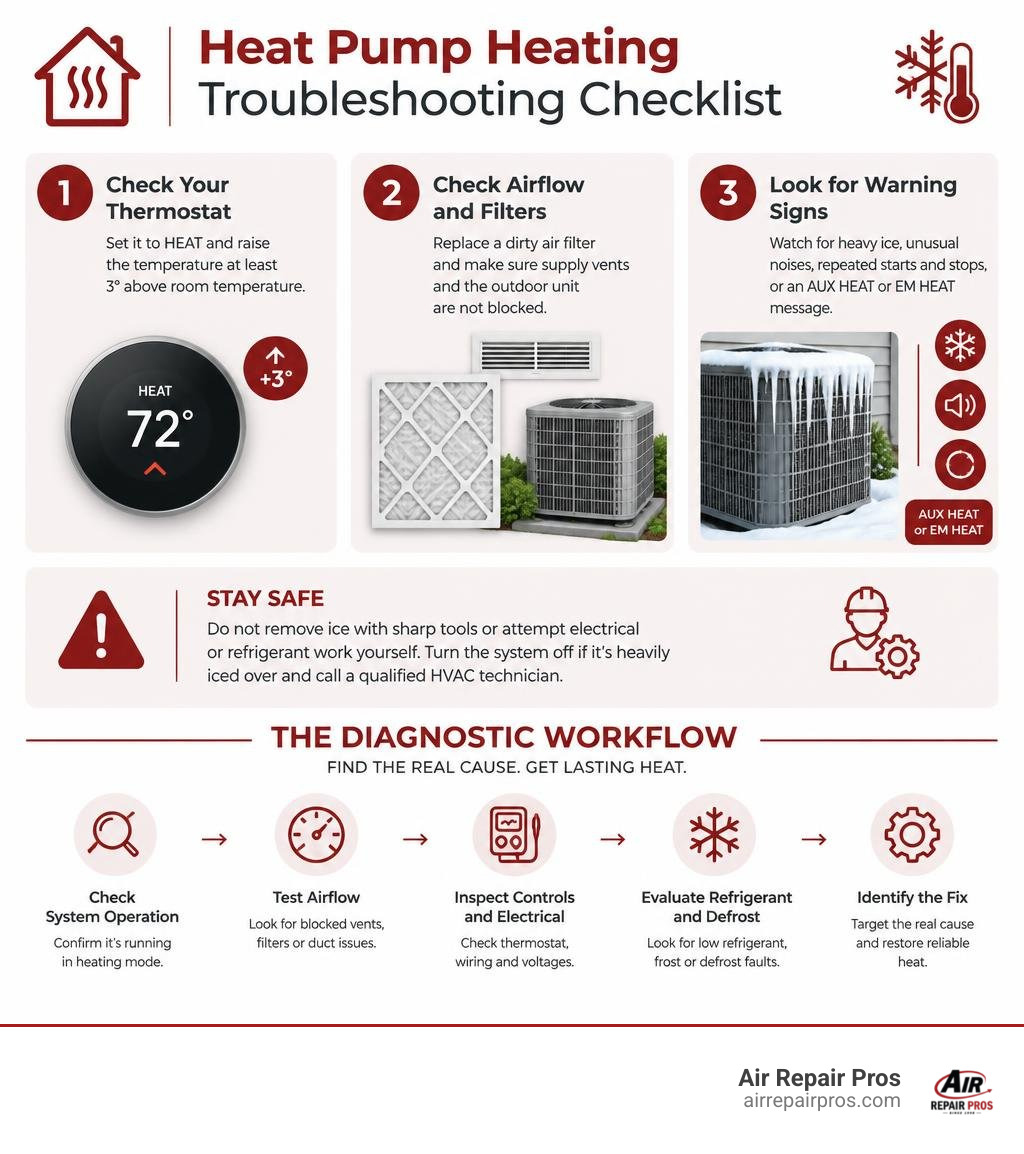
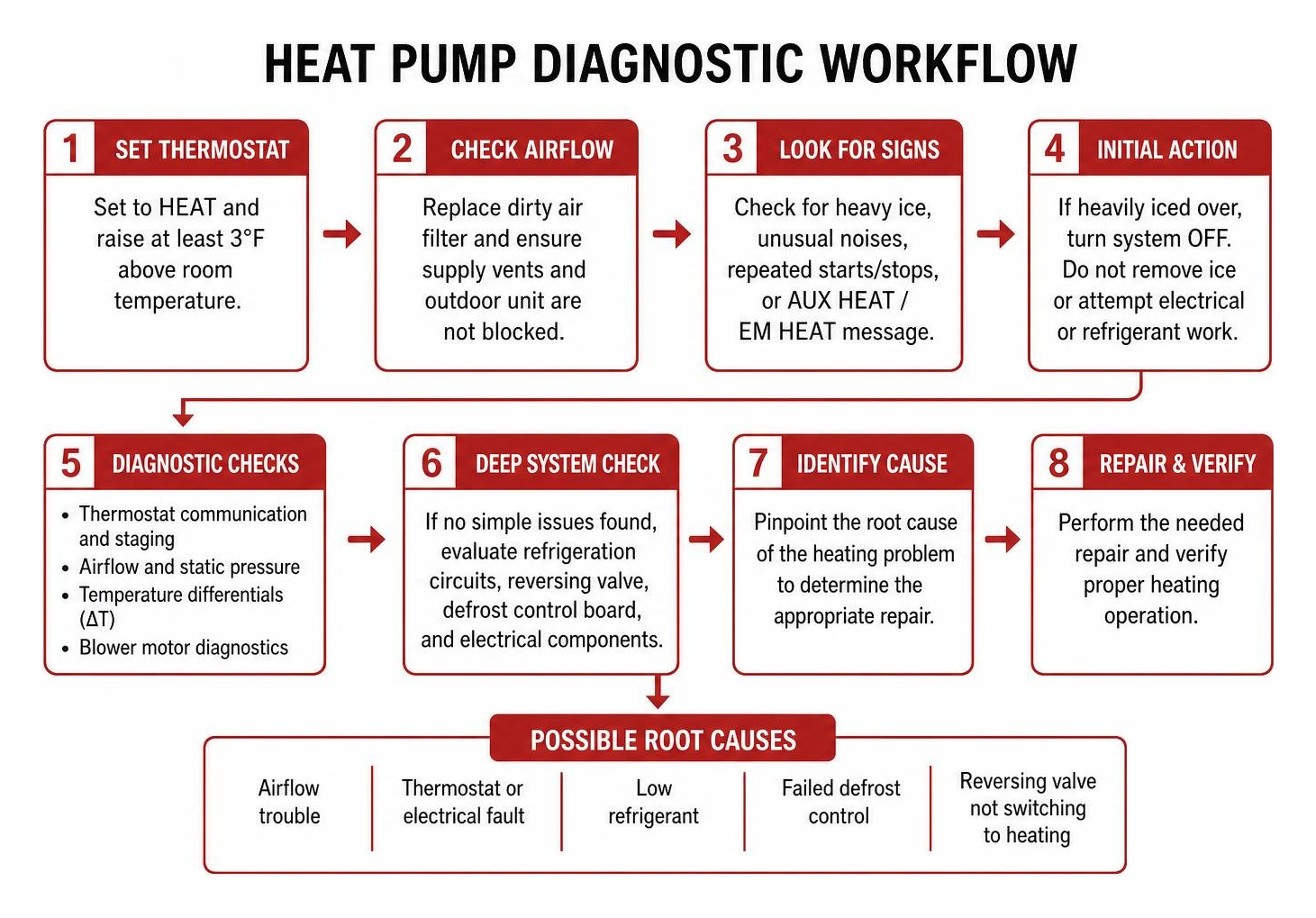
- Confirm thermostat configuration: Verify that the thermostat mode switch is firmly set to HEAT rather than COOL or OFF. Increase the setpoint at least 3 degrees above current indoor ambient room temperature to trigger a continuous heating call across all stages.
- Inspect filters and return airflow: Check and replace dirty pleated air filters. Ensure all indoor supply registers, return grilles, and outdoor condensing clearances remain completely open and free from furniture, rugs, leaves, or outdoor debris.
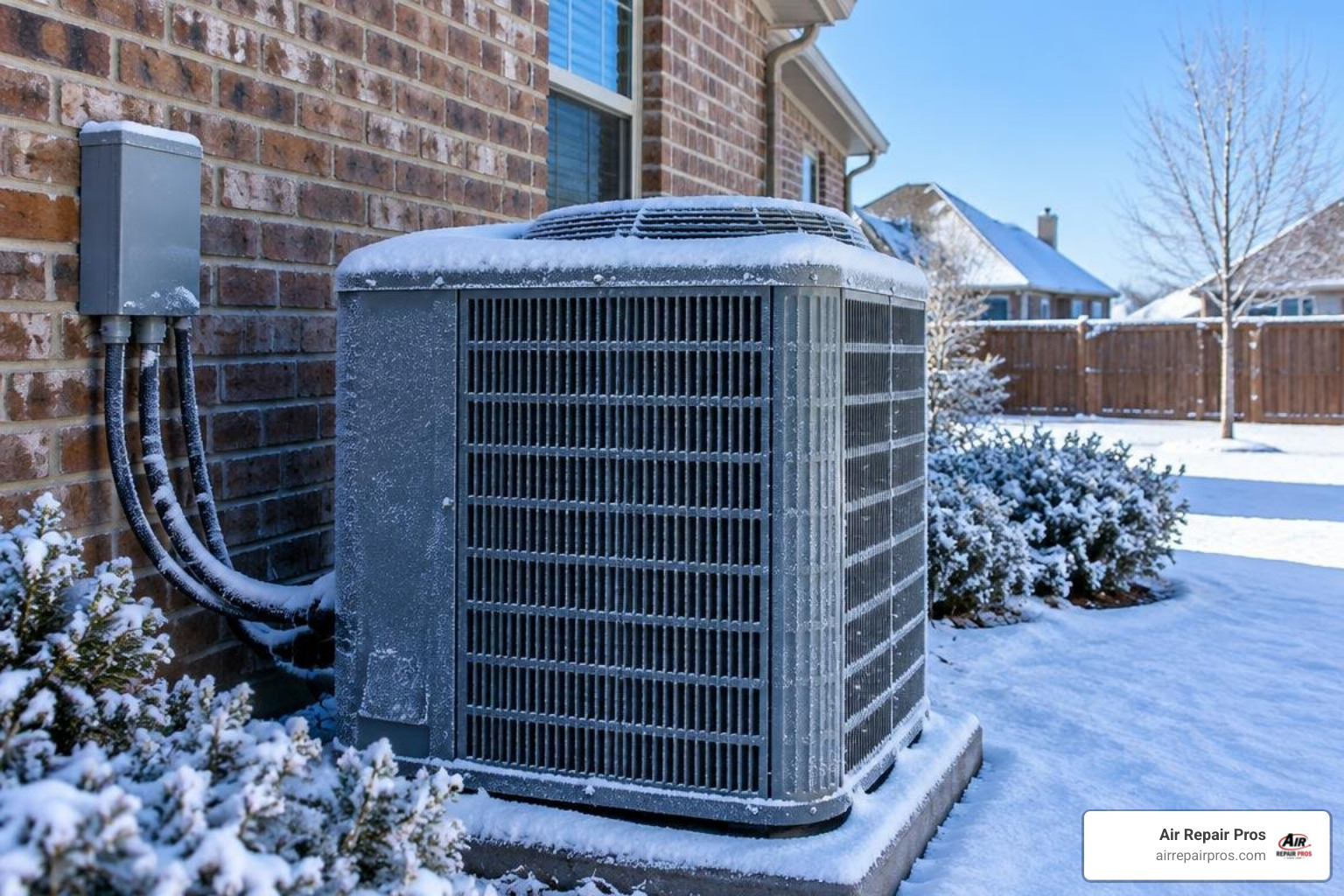
- Observe outdoor unit operation: Walk outside to inspect the exterior unit. Look for heavy encasements of solid ice across the coil fins, listen for unusual grinding or buzzing noises, check for rapid on-off cycling, and see if your indoor thermostat displays an unexpected AUX HEAT or EM HEAT notification.
These symptoms frequently point to restricted airflow, electrical control issues, low refrigerant volume, a stuck reversing valve, or a failed defrost control board. When you suspect a mechanical breakdown requiring residential heat pump repair, never attempt to chip ice away using screwdrivers, knives, or hammers, as sharp tools can easily puncture aluminum coil fins and copper refrigeration circuits. Turn the system off completely at the thermostat if heavy ice encases the outdoor unit, and call a licensed HVAC contractor for safe service.
Winters across North Dallas, TX, are typically moderate, but sudden Arctic cold fronts bring freezing temperatures that test the thermodynamic limits of heat pumps. In humid, sub-freezing weather, an outdoor unit should periodically cycle into defrost mode for a few minutes. If your outdoor unit remains frozen solid, blows cold air into your living areas for extended periods, or causes an alarming spike in your monthly utility bill, the equipment requires professional mechanical attention.
The certified service team at Air Repair Pros provides complete diagnostic evaluations in heating mode to inspect critical electrical controls, check airflow dynamics, and restore dependable, energy-efficient comfort to your home.
Key Diagnostic Steps for Residential Heat Pump Repair
When a heat pump fails to deliver warm air during freezing weather in Frisco, TX, jumping to conclusions can lead to unnecessary component replacements. A structured diagnostic workflow ensures that certified technicians identify the underlying mechanical or electrical fault accurately and safely.

Understanding how heat pumps extract outdoor heat is fundamental when evaluating heating performance gaps. Unlike standard gas furnaces that generate heat through fuel combustion, a heat pump absorbs ambient thermal energy from outdoor air and pumps it indoors using a closed-loop refrigeration cycle. When that thermodynamic cycle is compromised by electrical, mechanical, or airflow problems, heating performance drops rapidly.
Technicians carry out several vital diagnostic procedures:
- Thermostat Communication and Control Staging: Verifying that the indoor thermostat sends stable 24V control voltage to both the reversing valve (terminal O or B) and auxiliary heat relays (terminal W or AUX). Low-voltage wiring shorts, corroded terminal contacts, or misconfigured digital thermostats frequently prevent the compressor or backup electric resistance elements from activating properly.
- Static Pressure and Airflow Testing: Measuring total external static pressure (TESP) across the indoor air handler coil using dual-port manometers. Excessive static pressure caused by restrictive high-MERV filters, undersized supply plenums, or crushed flexible ductwork causes the indoor coil to overheat, tripping high-pressure safety switches and shutting down heating cycles.
- Temperature Differential ($Delta T$) Verification: Measuring dry-bulb air temperature entering the return duct versus conditioned air exiting supply registers. Under standard heating conditions, a properly charged heat pump produces a temperature split between 15°F and 25°F. A temperature rise below 10°F indicates compromised heat exchange, low refrigerant charge, or a failing metering device.
- Blower Motor Output: Testing electronically commutated motors (ECM) and variable-speed blower assemblies to confirm the system delivers rated cubic feet per minute (CFM) across indoor heat exchanger coils.
When standard airflow checks reveal no obvious blockages, homeowners need expert heat pump repair in Frisco, TX from experienced technicians who can safely evaluate pressurized refrigeration lines and high-voltage electronics.
Reversing Valve and Defrost Board Failures Requiring Residential Heat Pump Repair
The four-way reversing valve is the mechanical component that allows a heat pump to provide both cooling in summer and heating in winter. This brass valve redirects high-pressure, superheated refrigerant discharge gas, switching the outdoor coil from a condenser in cooling mode into an evaporator during heating mode.
Common reversing valve failures include:
- De-energized or Shorted Solenoid Coil: If the electrical solenoid coil burns out or loses its 24V control signal, the internal pilot valve cannot redirect pressure to slide the brass piston. Depending on system engineering, the valve may default to cooling mode, leaving the house freezing in January.
- Internal Slider Bypass: Internal Teflon slider seals can degrade, wear out, or become mechanically jammed by particulate debris or acidic oil. When an internal leak occurs, high-pressure discharge gas bypasses directly into the suction line, eliminating heating capacity while elevating compressor operating temperatures.
- Defrost Control Board Malfunctions: In cold, humid winter weather, frost naturally forms across the exterior coil fins. The electronic defrost control board uses thermistors and timed intervals to reverse the system into cooling mode temporarily, melting ice buildup while activating auxiliary heat strips to keep indoor supply air comfortable. If the defrost sensor drifts out of calibration, the system fails to defrost, encasing the outdoor unit in thick ice.
Official performance guidelines published by the U.S. Department of Energy indicate that faulty defrost controls and reversing valve malfunctions dramatically increase electrical power consumption while accelerating compressor degradation.
When Electrical Malfunctions and Sensor Errors Demand Residential Heat Pump Repair
Electrical systems endure substantial thermal and mechanical stress throughout continuous year-round cycling in North Texas:
- Dual Run Capacitor Degradation: Capacitors deliver the starting phase shift and running torque necessary for outdoor fan motors and compressors. As capacitance ratings drift below specified microfarad ($mutext{F}$) tolerances, motors pull excess amperage, run hotter, and eventually overheat safety cutouts.
- Pitted Contactor Points: High-voltage magnetic contactors channel 240V power to the compressor and fan. Over time, electrical arcing produces carbon buildup and metal pitting on contact surfaces, leading to severe voltage drops, persistent humming, or stuck contacts that run outdoor equipment nonstop.
- Inverter Boards and Thermistors: Modern variable-capacity heat pumps depend on complex inverter drive electronics and electronic thermistors. A drifted ambient temperature sensor can send erroneous readings to the master controller, shutting down the compressor and forcing expensive emergency resistance heating strips to operate continuously.
Safety Warning: Heat pump electrical cabinets contain high-voltage 240V circuits and large motor capacitors that store lethal electrical energy even after the main circuit breaker is turned off. Homeowners should never open electrical disconnect panels or touch wiring terminals. Always rely on certified HVAC professionals equipped with properly insulated diagnostic multimeters to perform electrical troubleshooting safely.
Common Reasons Your North Dallas Heat Pump Isn’t Heating
When an HVAC system fails during sub-freezing temperatures in McKinney, TX, or Plano, TX, several distinct mechanical faults are commonly uncovered during on-site evaluations. Identifying and rectifying these problems promptly protects expensive internal components from irreversible damage.
Scheduling comprehensive professional heat pump services ensures that your system receives thorough testing from technicians who understand complex refrigeration and electrical circuitry.
Refrigerant Leaks and Metering Device Restrictions
An air-source heat pump operates by circulating a precise factory charge of specialized refrigerant to absorb outdoor thermal energy and transfer it indoors. Unlike an automobile engine that consumes motor oil over time, an HVAC system is a hermetically sealed closed loop that should never lose refrigerant unless a physical leak develops.
- Vibration and Corrosion Pinhole Leaks: Formicary corrosion, thermal expansion, and mechanical vibration can create microscopic pinhole leaks in copper lines and aluminum U-bends. As refrigerant gradually leaks out, suction pressure plunges, causing outdoor coils to frost over, heating capacity to drop, and compressor runtimes to extend indefinitely.
- Thermal Expansion Valve (TXV) Failures: The TXV precisely meters liquid refrigerant entering the indoor coil during heating operation. If the power head loses its internal charge, or if internal debris clogs the microscopic metering port, refrigerant flow is severely restricted. This starving condition causes high superheat, diminished heat output, and dangerous compressor overheating.
- Restricted Liquid Line Filter-Driers: Moisture contamination or desiccant degradation can cause a significant pressure drop across the liquid line filter-drier, restricting total refrigerant mass flow throughout the heating circuit.
Winter Peak Demands and Auxiliary Heat Strip Lockouts
During severe winter cold snaps across North Texas, ambient outdoor temperatures occasionally fall below an air-source heat pump’s thermal balance point. At this temperature, secondary electric resistance heat strips must energize to provide supplementary heating.
- Failed Sequencers and Relays: Electric resistance heat strips use multi-stage heat sequencers to stage heating elements on sequentially, preventing massive instantaneous power surges. If a sequencer coil burns out, backup heat elements will not activate, leaving the home chilly when outside temperatures plummet.
- Stuck Heat Relays and Excessive Electric Bills: If a sequencer relay welds shut, electric resistance elements drawing 5 to 15 kW of power will run nonstop even after the thermostat reaches its setpoint. This malfunction produces massive utility bill spikes without improving overall indoor comfort.
- Smart Meter Consumption Anomalies: Reviewing interval energy data from digital smart meters often reveals constant, excessive power consumption patterns overnight, serving as an early indicator of stuck resistance strips or failing defrost controls.
Protecting your equipment before winter arrives is easy when you schedule thorough Frisco, TX, heat pump maintenance to inspect electrical connections, verify refrigerant pressures, and clean critical coil surfaces.
Repair vs. Replacement: Evaluating Costs, Lifespan, and Energy Efficiency
When faced with major equipment malfunctions during the winter heating season, homeowners must weigh the financial practicality of component repairs against a complete HVAC system replacement.
Reviewing key factors regarding heat pump lifespan and longevity provides valuable context for this decision. Most well-maintained heat pumps provide between 10 and 15 years of reliable operation in North Texas. If your system is more than 10 years old and experiences a catastrophic component failure, such as a grounded compressor, rotted coil assembly, or cracked inverter control board, investing in replacement is generally more cost-effective than continuous short-term repairs.
Efficiency standards have also evolved substantially. Older systems were rated using standard SEER and HSPF metrics, whereas modern heat pumps are manufactured according to updated DOE testing criteria, designated as SEER2 and HSPF2. High-efficiency systems certified under the Energy Star program provide advanced low-ambient heating capability, delivering steady warmth even when winter temperatures in Dallas, TX, drop into the teens and twenties.
Advanced building simulation tools like Building Energy Optimization (BEopt) show that upgrading an aging 10 SEER / 6.8 HSPF heat pump to a modern variable-speed inverter heat pump rated at 16+ SEER2 and 8.5+ HSPF2 reduces annual heating energy consumption by 20% to 40% in residential homes.
| Decision Factor | Minor Component Repair | Major System Overhaul | Full System Replacement |
|---|---|---|---|
| Typical Scope of Work | Capacitors, contactors, defrost sensors, blower relays | Reversing valve, fan motor, TXV, leak repair & recharge | Complete outdoor unit and indoor matched air handler |
| Equipment Age Applicability | Units of any age (1 to 15+ years) | Units under 8 to 10 years old with sound coils | Units 10 to 15+ years old or with obsolete R-410A phased-out designs |
| Impact on Energy Efficiency | Restores baseline operating efficiency | Restores factory rated efficiency | Increases seasonal efficiency (SEER2 / HSPF2 gains) |
| Warranty Coverage | 1-year repair parts and labor warranty | 1-year component warranty | 10-year manufacturer equipment warranty |
| Expected Equipment Lifespan Addition | Maintains expected 10 to 15 year system lifespan | Adds 2 to 5 years of functional service life | Resets equipment lifecycle to 15+ years |
When exploring full equipment upgrades, evaluating modern energy-efficient heat pump installations provides a clear view of multi-stage performance, enhanced dehumidification, and lower operating costs.
Frequently Asked Questions About Residential Heat Pump Heating Issues
Why is my heat pump blowing cool air in heating mode?
A heat pump may blow lukewarm or cool air if it is currently executing an automated 5 to 10 minute defrost cycle, during which the system switches into cooling mode to melt outdoor coil frost. If the air coming from your vents remains cool for hours, typical causes include a stuck reversing valve, low refrigerant charge, a clogged air filter restricting airflow, or improper thermostat wiring.
How does ice buildup on the outdoor unit affect heating performance?
A light, uniform dusting of frost is normal during humid winter weather, but heavy, thick sheets of ice block air from flowing across the outdoor coil fins. When airflow is blocked, the refrigerant cannot absorb outdoor thermal energy, dropping system suction pressure and risking permanent mechanical damage to the outdoor fan blades and compressor.
What is the difference between auxiliary heat and emergency heat?
Auxiliary heat operates automatically as a secondary heating stage when outdoor temperatures drop below the heat pump balance point, supplementing the compressor to maintain indoor setpoints. Emergency heat is a manual thermostat setting that completely disables the outdoor compressor, forcing the system to heat the home exclusively using high-consumption electric resistance heat strips.
How can data logging and smart meters help diagnose heat pump failures?
Smart meters record hourly kilowatt-hour consumption and peak electrical demand. Sustained, unusual 5 to 10 kW spikes during mild winter conditions or continuous cycling patterns indicate that the compressor is drawing excessive amperage, the defrost board is failing, or auxiliary resistance strips are stuck in an energized state.
When does a stuck reversing valve require component replacement?
If diagnostic testing confirms that the solenoid coil is receiving its full 24V control signal and generating a magnetic field, but internal pressures fail to switch between heating and cooling modes, the internal mechanical slide is physically jammed. In this situation, the sealed four-way valve must be recovered, cut out of the refrigeration loop, and replaced with a new factory valve.
How do thermal simulation tools like BEopt guide repair decisions?
Simulation software models home building envelopes, insulation levels, window ratings, and regional weather patterns to calculate exact heating and cooling loads. By comparing projected utility savings between repairing an existing unit versus installing a higher HSPF2 model, homeowners can make data-backed financial decisions.
Why is my heat pump short cycling during cold weather?
Short cycling occurs when the heat pump starts and shuts down every few minutes without finishing a full heating cycle. Common culprits include a dirty air filter tripping the high-temperature safety limit switch, an overcharged refrigerant circuit, an oversized HVAC system, or a thermostat placed directly in the path of a warm supply register.
How does North Dallas winter weather impact heat pump heating capacity?
Winters in Dallas, TX, bring mild weather punctuated by sharp, fast-moving cold fronts. In mild conditions between 45°F and 60°F, heat pumps operate at peak thermal efficiency. When temperatures fall below freezing, heating capacity declines naturally, making clean coils, unobstructed ductwork, and functional electric heat sequencers critical for comfort.
What are the typical costs of repairing common heat pump components?
Repair costs vary depending on the specific part, accessibility, warranty coverage, and whether refrigerant recovery is necessary. Minor electrical repairs like capacitors or contactors are economical, whereas sealed-system repairs like reversing valves, TXV replacements, or locating and brazing coil leaks require specialized recovery and brazing equipment.
How do modern tax incentives influence the decision to repair or replace?
Federal energy efficiency incentives and regional utility rebates allow homeowners to offset a significant portion of new high-efficiency heat pump installation costs. When an older unit requires costly mechanical repairs, applying federal tax credits makes upgrading to a modern, variable-speed heat pump a sensible long-term financial choice.
Conclusion: Restoring Winter Comfort in North Dallas, TX
Recognizing early warning signs of heat pump trouble, such as weak airflow, unusual squealing or grinding noises, persistent ice on the outdoor coil, or sudden spikes on your monthly electric utility bill, allows you to address mechanical faults before minor wear escalates into complete system breakdown. Proactive maintenance, timely filter replacements, and regular professional inspections ensure your heating system maintains high efficiency throughout the winter months. If your equipment is approaching the end of its useful lifespan, taking advantage of current heat pump tax credit incentives can help offset the cost of upgrading to a modern, high-efficiency system.
When winter temperatures drop across Dallas, TX, Plano, TX, McKinney, TX, Allen, TX, Little Elm, TX, and Frisco, TX, having reliable heating is essential for your family’s comfort and safety. The certified technicians at Air Repair Pros arrive with fully stocked service trucks carrying more than 85% of essential replacement parts to complete your residential heat pump repair on the very first visit. For dependable same-day diagnostic service and 24/7 emergency response, please contact our professional heat pump specialists today.