

Is It Time for Water Heater Replacement in Little Elm, TX?
Water heater replacement in Little Elm, TX is one of the most common plumbing needs facing homeowners in this fast-growing North Dallas community. If your unit is aging, leaking, or leaving you with lukewarm showers, you may already be past the point where a repair makes sense.
Here is a quick overview of what Little Elm homeowners need to know:
- When to replace: Most tank water heaters last 8 to 12 years. If yours is older than that and showing problems, replacement is usually the smarter call.
- Permit required: Yes. The Town of Little Elm requires a permit for all water heater replacements. The permit fee is a standard municipal charge, and a final inspection is mandatory.
- Tank vs. tankless: Tank systems are lower upfront cost. Tankless systems last longer, save energy, and deliver endless hot water.
- Installation time: A standard tank swap typically takes 2 to 4 hours. Tankless conversions can take longer.
- Hard water matters: Little Elm receives moderately hard water from Lake Lewisville and Lake Ray Roberts. This speeds up sediment buildup and can shorten your water heater’s life.
- Get a professional estimate: Pricing varies depending on the unit type, size, fuel source, and installation complexity.
Little Elm has grown quickly over the past decade and a half. The median home in the area was built around 2010, which means many water heaters installed during construction are now reaching or exceeding their expected lifespan. A failing water heater does not just mean cold showers. It can mean water damage, higher energy bills, and unexpected emergency calls.
Whether you are dealing with a sudden breakdown or planning a proactive upgrade, knowing your options early makes the process faster and less stressful. It is important to understand that local plumbing codes are strictly enforced to protect your property value and safety.
When you begin researching your options, you will find that modern systems are far more energy efficient than those manufactured just a decade ago. This means that while a replacement is an upfront investment, it immediately starts paying you back in the form of lower monthly utility bills and reduced repair risks.
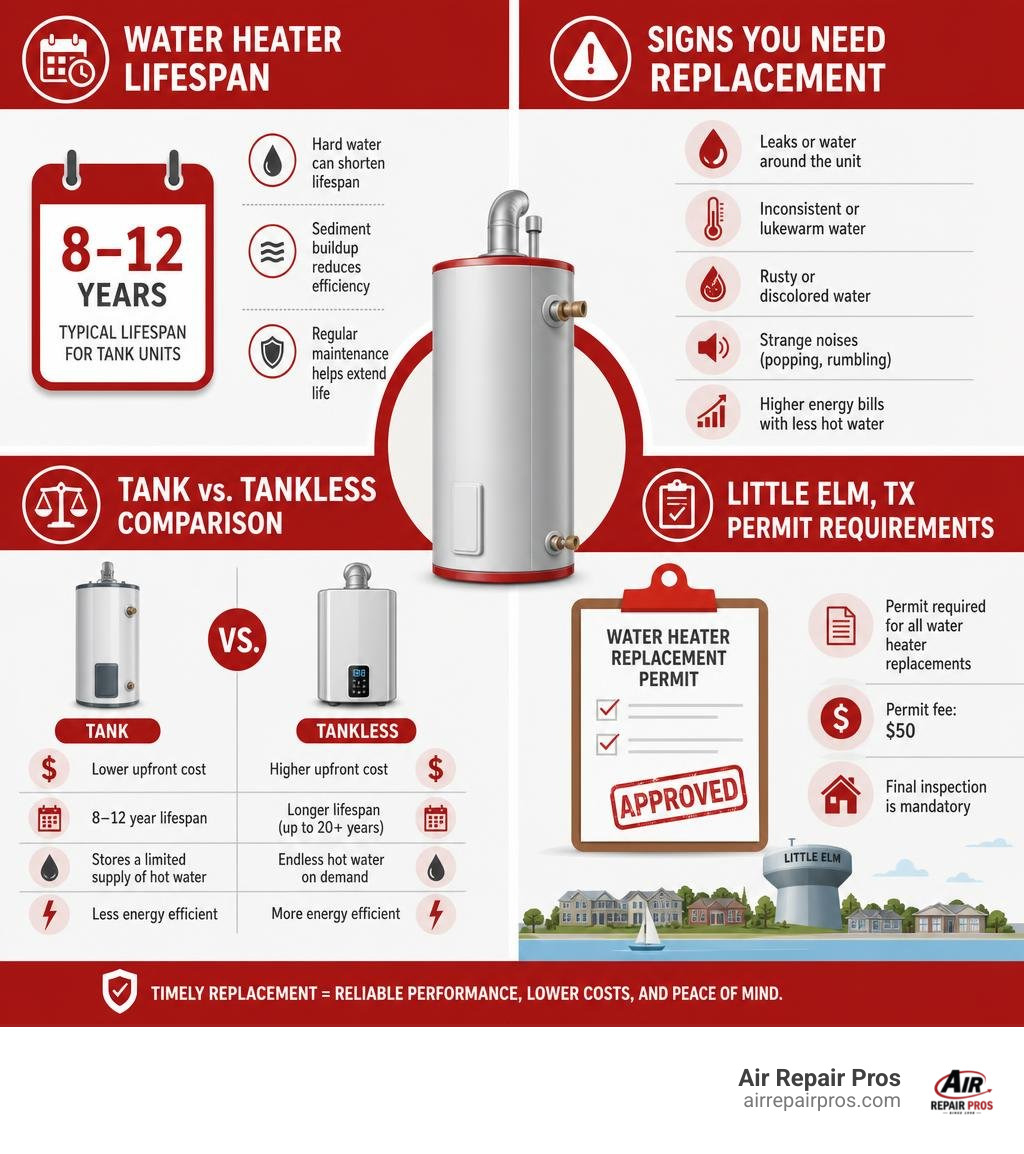
Signs You Need Water Heater Replacement in Little Elm, TX
Recognizing the warning signs of a failing water heater can save you from a major household disaster. Water heaters rarely break down without dropping a few hints first. By acting on these warning signs early, you can schedule a water heater replacement in Little Elm, TX on your own terms rather than dealing with an emergency flooded garage or closet.
System Age
The age of your system is the most reliable indicator of its remaining lifespan. Standard tank water heaters are engineered to last between 8 and 12 years. If your home was built during the local construction boom in the early 2010s and still has its original unit, you are living on borrowed time. Even if the system seems to be running fine, its internal components are likely degraded. Upgrading proactively prevents sudden failures.
Rusty Water and Metallic Taste
If your hot water has a red, brown, or rusty tint, or if you notice a distinct metallic taste, your water heater is likely corroding from the inside out. Tank water heaters contain a sacrificial anode rod designed to attract corrosive elements. Once this rod is completely depleted, the corrosive elements begin attacking the steel lining of the tank itself. If the rust is coming from the tank, timely water heater replacement is the only permanent solution.
Strange Noises and Popping Sounds
As water heaters age, minerals from the local water supply settle at the bottom of the tank. Over time, this sediment hardens into a thick scale layer. When the burner or heating element cycles on, water becomes trapped beneath this crust, boils, and bubbles up. This creates distinct knocking, popping, or rumbling noises. Not only does this sediment layer make your system incredibly noisy, but it also acts as a barrier, forcing the unit to run longer and hotter, which eventually cracks the tank steel.
Leaking Tank
A puddle of water around the base of your water heater is an immediate red flag. While some leaks originate from loose valves or connections, which can be resolved with professional repair, a leak originating from the tank body itself is terminal. Metal expands and contracts as it heats and cools. Over time, this constant movement causes tiny fractures in a corroded tank, leading to slow leaks or catastrophic bursts.
Temperature Fluctuations
Are you experiencing sudden blasts of cold water during your morning shower? If your water heater struggles to maintain a consistent temperature, or if you run out of hot water much faster than you used to, the heating elements or gas burners are failing. In older units, this decline in performance indicates that the system is reaching the end of its functional life. You might also notice that the water takes much longer to heat up than it did in the past, which points to a failing thermostat or heavy sediment accumulation.
Tank vs. Tankless Water Heater Replacement Options
When planning a water heater replacement in Little Elm, TX, one of the biggest decisions you will make is choosing between a traditional storage tank system and a modern tankless unit. Both options have distinct advantages, and the right choice depends on your household size, hot water demands, and long-term goals.
Traditional Storage Tank Water Heaters
Storage tank water heaters remain the most common choice for many local homes. These systems keep a preheated reservoir of water, usually 40 to 50 gallons, ready for use at all times.
- Pros: They feature a lower initial equipment and installation cost. They are also simpler to install, making direct swaps quick and straightforward.
- Cons: They consume energy continuously to maintain water temperature, a phenomenon known as standby heat loss. They also have a limited hot water supply, meaning back-to-back showers can deplete the tank.
Tankless Water Heaters
Tankless water heaters, often called on-demand systems, do not store hot water. Instead, they use high-powered burners or electric elements to heat water instantly as it flows through the unit.
Pros: They offer an endless supply of hot water and are highly energy-efficient because they only operate when a tap is turned on. They also feature a compact, space-saving design that mounts directly to the wall, freeing up valuable floor space in your garage or utility closet.
Cons: They require a higher upfront investment. Retrofitting a home for a tankless system may also require modifications to your gas lines, electrical circuits, or venting systems.
If you are interested in switching to a highly efficient system, investing in tankless water heaters can significantly lower your monthly utility bills. Professional installation ensures that your gas lines and venting systems are properly configured to support the high-demand burners of these modern units.
| Feature | Traditional Storage Tank | Tankless Water Heaters |
|---|---|---|
| Average Lifespan | 8 to 12 Years | 15 to 20+ Years |
| Energy Efficiency | Standard (Subject to standby heat loss) | High (Heats water only on demand) |
| Hot Water Supply | Limited to tank capacity | Endless and continuous |
| Physical Space Required | Large footprint (Requires floor space) | Compact (Wall-mounted design) |
| Upfront Cost | Lower initial investment | Higher initial investment |
| Maintenance Requirements | Annual tank flush | Annual scale descaling |
Local Building Codes and Permit Requirements in Little Elm, TX
You cannot simply buy a water heater from a local retail store and install it yourself without notifying local authorities. The Town of Little Elm enforces strict plumbing codes to protect your safety, your property, and the local municipal water supply.
According to the official Town of Little Elm Water Heater Replacement Requirements, all water heater replacements within the town limits require a plumbing permit. This permit ensures that the installation meets the International Residential Code (IRC) and local amendments.
Key Code Requirements in Little Elm
- Permit Fees: A standard permit fee is required by the town for water heater replacement.
- Thermal Expansion Tanks: Because Little Elm utilizes a closed public water system, heating water causes pressure to build up inside your home plumbing. An expansion tank must be installed on the cold water line above the water heater to safely absorb this excess pressure and prevent pipe damage.
- Sediment Traps: For gas-powered water heaters, a sediment trap (sometimes called a dirt leg) must be installed on the gas line before it connects to the unit. This trap catches moisture, debris, and metal shavings before they can clog the gas control valve.
- Safety Pans and Drain Lines: If your water heater is located inside your living space, an attic, or on a wooden platform where a leak could cause property damage, a safety pan must be placed under the unit. This pan must connect to a drain line that routes the water safely outside the home.
- Final Inspections: Once the installation is complete, you must schedule a final inspection with the Town of Little Elm Building Safety Division. A certified inspector will visit your home to verify that the expansion tank, sediment trap, venting, and safety valves are installed correctly.
The Professional Water Heater Replacement Process
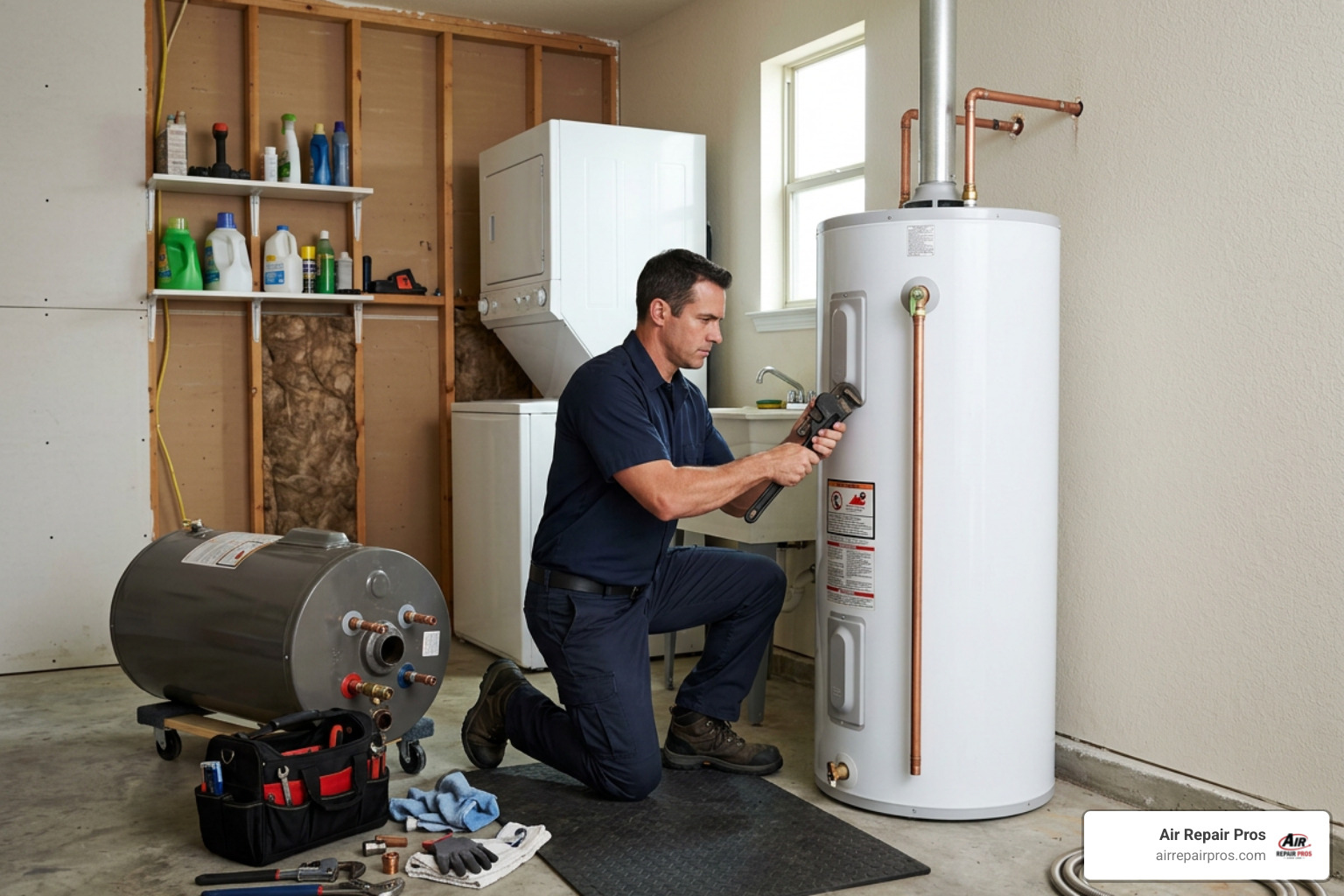
Replacing a water heater is a complex task that involves water, high-voltage electricity, and highly flammable natural gas. Hiring a licensed professional is the best way to ensure the job is done safely and correctly.
When you schedule expert installation, the process follows a structured sequence designed to minimize disruption to your home:
- Pre-Installation Assessment: A licensed plumber inspects your existing setup, verifies utility connections, and helps you select the correctly sized unit for your household.
- System Shutoff and Draining: The technician shuts off the main water supply, turns off the gas or electricity, and safely drains the existing tank.
- Old Unit Disconnection and Removal: The plumber disconnects the water, gas, and vent lines, then carefully removes the old unit from your home.
- Platform and Utility Preparation: The installation area is cleaned and inspected. Any necessary modifications, such as installing a new safety pan or upgrading gas lines, are completed.
- New Unit Installation: The new water heater is positioned, leveled, and secured. The technician connects the water lines, installs the mandatory thermal expansion tank, and hooks up the gas or electrical connections.
- Venting and Safety Setup: For gas units, the venting system is carefully inspected to ensure combustion gases safely exit your home. The temperature and pressure relief valve is installed and routed.
- System Testing and Calibration: The tank is filled with water, pressurized, and checked thoroughly for leaks. The technician ignites the burner or powers up the elements, calibrates the thermostat to a safe temperature, and verifies proper operation.
- Clean-Up and Haul-Away: The old unit is loaded onto the service truck for proper recycling and disposal, leaving your utility space clean.
By trusting your replacement to Little Elm plumbing services, you can rest assured that your new system is safe, efficient, and fully code-compliant.
How to Choose Between Repair and Full Replacement
Faced with a malfunctioning water heater, homeowners often wonder if they can get away with a quick repair or if they need to invest in a full replacement. Consider these factors when making your decision:
The Age of the Unit
If your water heater is under 8 years old, repairing a faulty component, such as a thermostat, heating element, or thermocouple, is usually highly cost-effective. However, if your system is past its tenth year, investing money into repairs is often a temporary fix for an inevitably failing system.
The Cost of the Repair
A good rule of thumb is the 50% rule. If the estimated cost of repairing your current water heater is close to half the cost of a brand-new system, replacement is the more financially sound option.
Frequency of Breakdowns
Have you called a plumber multiple times over the past year to fix your water heater? Frequent breakdowns are a clear sign of system fatigue. Multiple minor repairs can quickly add up to the cost of a new, highly reliable unit.
Tank Integrity
If the tank itself is leaking, there is no choice to make. Internal tank corrosion cannot be repaired. You must replace the unit immediately to avoid catastrophic water damage to your home. For homeowners comparing repair costs, professional water heater repair can help identify whether a component fix is practical or whether replacement is the safer long-term choice.
Maintenance Tips to Extend the Lifespan of Your New System
Once you invest in a new water heater, you want to protect that investment. Performing simple, regular maintenance can extend the lifespan of your system, keep your utility bills low, and prevent unexpected breakdowns.
Flush the Tank Annually
The water supply in Little Elm, sourced from Lake Lewisville and Lake Ray Roberts, contains moderate levels of minerals like calcium and magnesium. When heated, these minerals crystallize and settle at the bottom of the tank. Performing an annual tank flush clears out this sediment, preventing hot spots and keeping your heating elements running efficiently.
Inspect the Sacrificial Anode Rod
The anode rod is a metal rod that hangs inside your tank. Its sole purpose is to corrode so your steel tank does not have to. You should have a professional inspect this rod every three years. If the rod is heavily degraded, replacing it is an inexpensive way to add years to your tank’s life.
Test the Temperature and Pressure (T&P) Relief Valve
The T&P valve is your water heater’s primary safety feature. It is designed to release water if the internal pressure or temperature exceeds safe limits. Gently lifting the valve lever once a year ensures that it operates freely and is not stuck or clogged with mineral scale.
Consider a Whole-Home Water Softener
Because hard water is the primary cause of premature water heater failure in North Texas, installing a water softening system can protect your plumbing. A water softener removes scale-producing minerals before they ever reach your water heater, drastically reducing sediment buildup and maximizing system efficiency.
Scheduling routine water heater maintenance with a licensed professional is the easiest way to keep your system running optimally for years to come.
Frequently Asked Questions About Water Heater Replacement
How long does a typical water heater last in Little Elm, TX?
A traditional storage tank water heater typically lasts between 8 and 12 years. Tankless water heaters can last 15 to 20 years, or even longer, with regular maintenance. The moderately hard water in the local area can cause faster mineral buildup, which may shorten these lifespans if the system is not flushed regularly.
What is the average timeline for a water heater replacement Little Elm TX?
A standard, direct swap of a traditional tank water heater usually takes between 2 and 4 hours. If you are converting from a tank system to a tankless water heater, the process can take 4 to 6 hours or longer because of the necessary gas line, electrical, and venting modifications.
Do I need a permit for water heater replacement Little Elm TX?
Yes. The Town of Little Elm requires a plumbing permit for all water heater replacements. A permit fee is required, and a final safety inspection by a city inspector is mandatory to ensure code compliance.
Why is my water heater making popping or rumbling noises?
Popping or rumbling noises are caused by sediment accumulation at the bottom of the tank. Mineral scale from hard water traps water beneath it. When the burner heats up, this trapped water boils and steam bubbles burst through the sediment layer, creating noisy vibrations.
Can I switch from a traditional tank to a tankless water heater?
Yes, most homes can be retrofitted for a tankless water heater. This conversion requires planning for proper venting, upgrading gas lines to support higher BTU demands, and ensuring adequate electrical supply for the unit’s controls.
Does hard water in Little Elm, TX affect my water heater?
Yes. Little Elm’s water supply contains minerals that form scale when heated. This scale coats heating elements, settles at the bottom of tanks, reduces energy efficiency, and can cause the tank steel to overheat and crack prematurely.
What are the signs of a leaking water heater tank?
Common signs include pooling water around the base of the unit, damp drywall nearby, rust stains on the outer jacket of the heater, and corrosion around the bottom of the tank.
Are there energy-efficiency rebates available for water heater upgrades?
Yes. Homeowners who install high-efficiency tankless or hybrid heat pump water heaters may qualify for federal tax credits. Local utility companies also occasionally offer rebates for certified energy-efficient appliances.
What safety features are required by Little Elm building codes?
Little Elm building codes require a thermal expansion tank, a temperature and pressure relief valve with dedicated discharge routing, sediment traps on gas lines, and safety pans with drain lines for units located inside living spaces or attics.
How do I shut off my water heater in an emergency?
For gas units, turn the gas valve on the supply line clockwise to the off position. For electric units, turn off the dedicated circuit breaker in your electrical panel. To stop water flow, turn the cold water shutoff valve located above the water heater clockwise.
Conclusion
A reliable supply of hot water is essential for your daily comfort, health, and household tasks. When it is time for a water heater replacement in Little Elm, TX, working with an experienced team ensures that your new system is sized correctly, installed safely, and fully compliant with all local building codes.
For nearly three decades, Air Repair Pros has provided dependable, high-quality residential plumbing, AC, and HVAC solutions across North Dallas, including Frisco, TX, McKinney, TX, Plano, TX, Allen, TX, and Little Elm, TX. With fully stocked trucks carrying over 85% of the parts needed for one-trip service, 24/7 emergency availability, and background-checked, certified technicians, the team is always ready to restore comfort to your home.
If your water heater is showing signs of failure or you are ready to upgrade to an energy-efficient tankless system, contact our professional water heater technicians today to schedule your in-home assessment and estimate.