

What McKinney, TX Homeowners Need to Know About Water Heater Installation Cost
Water heater installation cost in McKinney, TX is one of the most common questions homeowners ask when their unit starts acting up or finally gives out. Here is a quick answer so you can get your bearings right away.
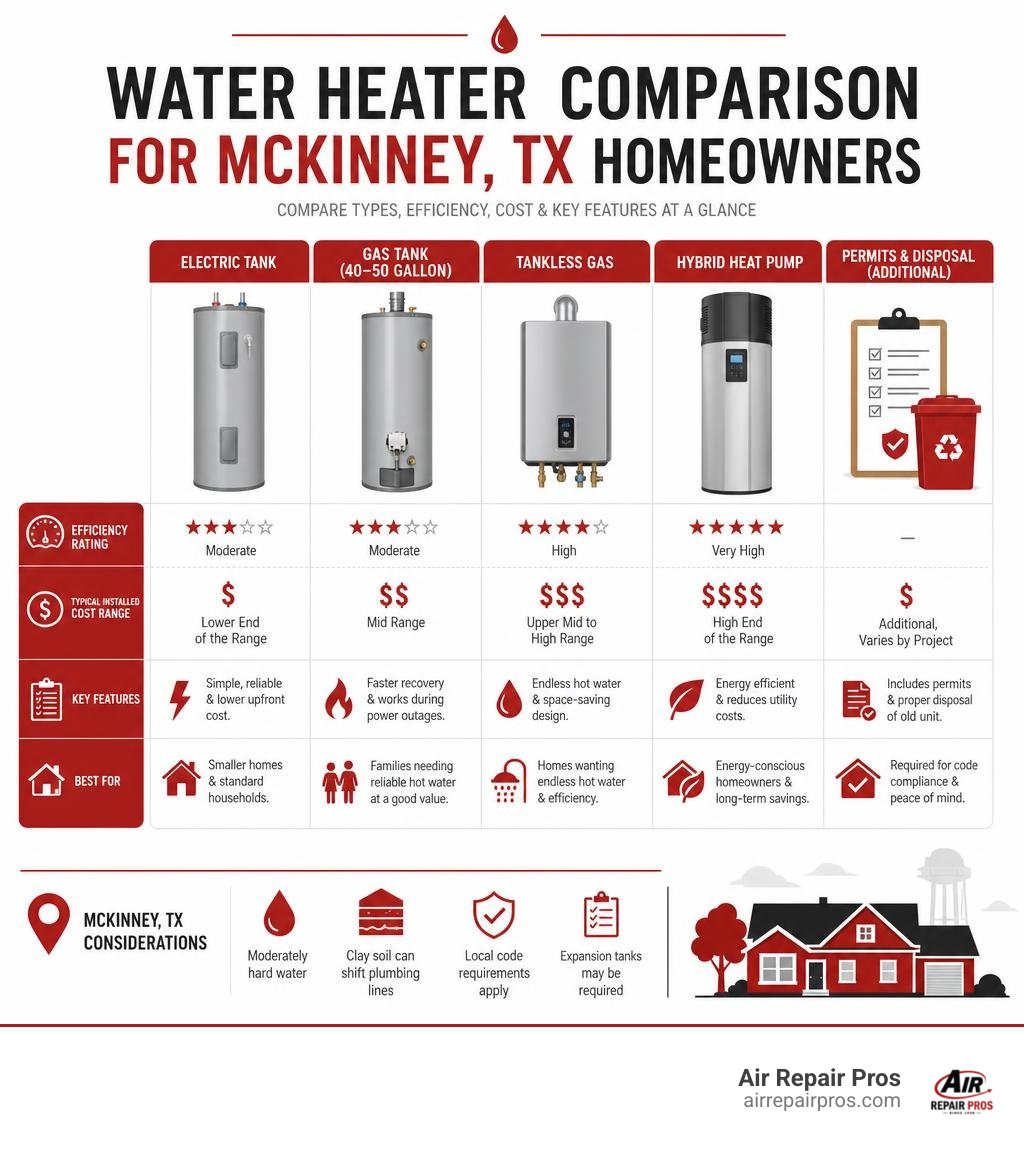
Quick Cost Summary: Water Heater Installation in McKinney, TX
| Water Heater Type | Typical Installed Cost Range |
|---|---|
| Electric Tank | Lower end of the range |
| Gas Tank (40 to 50 gallon) | Mid range |
| Tankless Gas | Upper mid to high range |
| Hybrid Heat Pump | High end of the range |
| Permits and Disposal | Additional, varies by project |
Pricing can vary depending on several factors, including the type of unit, fuel source, your home’s existing infrastructure, and current labor rates in Collin County. Homeowners should always request a professional estimate before committing to a specific system.
More than 25% of a typical North Texas home’s energy use goes toward heating water. That makes your water heater one of the most important systems in your home, yet most people in McKinney, TX only think about it when a cold shower interrupts their morning routine.
McKinney, TX is a fast-growing city with a diverse mix of housing. Older homes near Historic Downtown have different plumbing needs than newer subdivisions like Craig Ranch or Stonebridge Ranch. That variety means installation complexity, and therefore cost, can shift quite a bit from one address to the next.
There are also local factors unique to this area, like moderately hard water, clay soil that can shift plumbing lines, and Texas code requirements like mandatory expansion tanks, that make McKinney, TX water heater projects different from a simple swap and go job elsewhere.
This guide covers everything you need to make a confident, informed decision, from understanding what drives costs to knowing when to repair versus replace.
Understanding Water Heater Installation Cost McKinney TX
When planning for a new water heater, understanding the components that make up the total water heater installation cost McKinney TX homeowners encounter is essential. The overall price is never just the retail price of the metal tank you see sitting on a showroom floor. Instead, it is a combination of equipment choice, professional labor, local code requirements, and structural modifications.
Several primary cost variables dictate where your final estimate will fall:
- Unit Size and Capacity: A system designed for a two-bedroom townhome in Adriatica will require less heating capacity than a large, multi-story estate in Stonebridge Ranch. Larger tanks or higher flow-rate tankless units naturally cost more.
- Fuel Source: Choosing between natural gas and electricity impacts both the upfront equipment pricing and the infrastructure needed to support the system.
- Installation Complexity: If your system is located in an easily accessible garage closet, labor is straightforward. If it is tucked away in a tight attic space or a cramped second-story closet, the physical labor involved in safely maneuvering the heavy system increases the overall cost.
Labor rates in Collin County and the surrounding North Dallas suburbs tend to reflect the highly skilled nature of the local workforce. Texas has strict plumbing standards enforced by the Texas State Board of Plumbing Examiners. In McKinney, TX, municipal codes require that any water heater installation or replacement be performed by a licensed professional who must pull a permit and schedule a post-installation safety inspection.
These local regulations are designed to protect your household from hazardous scenarios like gas leaks, carbon monoxide poisoning, and high-pressure system explosions. They also help ensure your new water heater is installed safely, inspected properly, and suited to the plumbing conditions in your specific McKinney, TX home.
Comparing Tank vs. Tankless Systems in McKinney, TX
Choosing the right type of water heater is the biggest decision you will make during this process. Each system has unique mechanical operations, space requirements, and long-term utility impacts. The table below outlines how these two popular options compare across several key performance categories.
| Performance Category | Traditional Tank Systems | Tankless Systems |
|---|---|---|
| Storage Capacity | High (typically 40 to 80 gallons of pre-heated water) | None (heats water on demand as it flows) |
| Hot Water Delivery | Limited to tank size; requires recovery time | Unlimited continuous flow for sequential use |
| Space Requirements | Large footprint; requires floor space | Compact; wall-mounted indoors or outdoors |
| Average Lifespan | Approximately 8 to 12 years | Approximately 15 to 20+ years |
| Energy Efficiency | Moderate; subject to standby heat loss | High; only consumes energy when water is running |
| Upfront Cost | Lower equipment and installation costs | Higher initial investment for unit and retrofitting |
Understanding these differences helps clarify why upfront costs vary so widely. If you are interested in maximizing your home’s square footage and eliminating standby energy waste, Air Repair Pros can help you compare conventional options with tankless water heater installation based on your household’s hot water demand, gas capacity, and available space.
Traditional Tank Water Heater Installation Cost McKinney TX
Traditional tank water heaters remain the most common choice in North Texas due to their lower initial purchase price and straightforward installation process. These units work by constantly heating and maintaining a large volume of water in an insulated tank, ensuring hot water is ready the moment you open a tap.
When installing a tank system, infrastructure requirements depend heavily on whether your home utilizes gas or electric power:
- Gas Tank Water Heaters: These systems require a dedicated gas line, a pilot light assembly, and a proper venting system to safely exhaust combustion gases out of your home. Gas units heat water roughly twice as fast as electric models, making them highly efficient for busy households.
- Electric Tank Water Heaters: These units rely on high-wattage electric heating elements submerged directly in the water. While they do not require venting or gas lines, they do need a dedicated high-voltage electrical circuit (typically 240-volt) to operate safely.
Proper sizing is crucial to avoid running out of hot water during peak usage times, such as busy mornings when multiple showers, the washing machine, and the dishwasher are running simultaneously. As a general rule of thumb, a household of one to two people requires a 40-gallon tank, three to four people require a 50-gallon tank, and households with five or more members should look at 75-gallon units or larger. A licensed technician can confirm the right size, placement, and code requirements during a traditional water heater installation appointment.
Tankless Water Heater Installation Cost McKinney TX
Tankless water heaters, often referred to as on-demand systems, are rapidly growing in popularity throughout McKinney, TX. Instead of maintaining a reservoir of hot water, these systems utilize high-powered gas burners or electric elements to heat water instantly as it passes through a compact heat exchanger.
While tankless systems offer incredible energy savings and endless hot water, transitioning from a traditional tank to a tankless system involves a more complex installation process. This transition often requires structural and utility modifications that can influence your overall project pricing:
- Gas Line Modifications: Tankless gas systems require a massive burst of energy to heat cold groundwater instantly. This means they often require larger gas lines (frequently upgrading from a half-inch line to a three-quarter-inch line) to deliver the necessary British Thermal Units (BTUs).
- Venting Upgrades: High-efficiency tankless units produce cooler exhaust gases, requiring specialized, corrosion-resistant PVC or polypropylene venting pipes rather than standard metal vents.
- Electrical Panel Upgrades: If you choose a whole-home electric tankless water heater, your home must have sufficient electrical capacity. These systems draw an immense amount of power, sometimes requiring multiple double-pole breakers and an upgrade to a 200-amp or larger electrical panel.
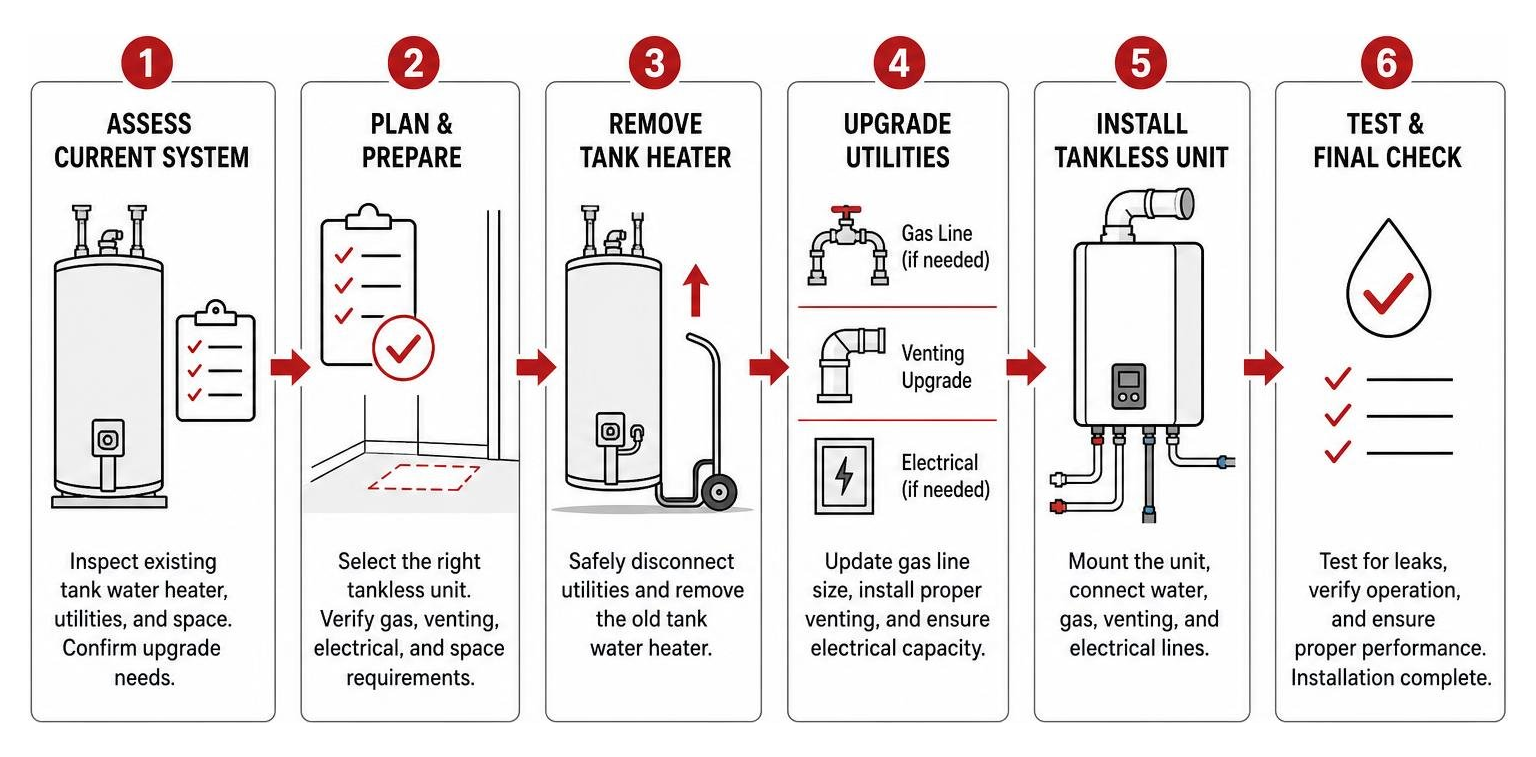
Despite these initial installation steps, the long-term utility savings and space-saving benefits make tankless systems an excellent investment for many modern homes. Homeowners comparing comfort upgrades often look at plumbing and HVAC efficiency together, and this McKinney HVAC tune-up guide explains how routine maintenance can support better performance across major home comfort systems.
Local Factors Affecting McKinney, TX Installation Pricing
McKinney, TX is a beautiful place to live, but our local environment and home construction trends present specific challenges that directly impact water heater installation and longevity.
One of the most significant regional challenges is our water quality. McKinney’s municipal water supply contains moderate to high levels of dissolved minerals, particularly calcium and magnesium. When this hard water is heated, these minerals precipitate out of the water and settle as a rocky sediment layer at the bottom of tank water heaters, or as scale inside the heat exchangers of tankless units. This sediment acts as an insulating barrier, forcing your system to work harder, run hotter, and consume more energy, which ultimately shortens its operational lifespan.
Another local factor is our notorious North Texas clay soil. The expansive clay soils in McKinney, Frisco, and Plano expand and contract dramatically with seasonal moisture changes. This shifting ground can cause foundation movement, which in turn puts physical stress on under-slab plumbing lines and the water lines entering your home. If a shifting foundation has compromised your plumbing connections, additional pipe leveling and stabilization work may be required before a new water heater can be safely installed.
Finally, home design in Collin County plays a major role. Many homes built in McKinney, TX after the late 1990s feature water heaters installed in the attic to save closet and garage space. Attic installations require extra safety precautions to protect your home from catastrophic water damage:
- Mandatory Drain Pans: A heavy-duty metal or approved plastic drain pan must be placed under the water heater to catch any slow leaks or condensation.
- Properly Routed Drain Lines: The drain pan must be connected to a dedicated drain line that safely routes water out of the attic and exhausts it outside the home, where a leak can be easily spotted.
- Thermal Expansion Tanks: Because McKinney utilizes closed plumbing systems containing pressure-reducing valves or backflow preventers, code dictates the installation of a thermal expansion tank. This small tank absorbs excess water pressure created as water heats up and expands, protecting your plumbing lines and water heater from high-pressure stress.
To learn more about how modern, energy-efficient appliances meet regional energy standards and help lower your monthly utility costs, you can learn about regional energy standards and efficiency guidelines from the U.S. Department of Energy website.
When to Choose Water Heater Repair vs. Replacement
It is a classic homeowner dilemma: do you patch up your existing water heater one more time, or bite the bullet and invest in a brand-new system? Knowing how to spot the warning signs of a failing unit can save you from a sudden, messy breakdown.
Keep an eye out for these diagnostic signs that indicate your system is struggling:
- Rusty or Discolored Water: If red, brown, or rusty water flows from your hot water taps but your cold water runs perfectly clear, it is a strong sign that the interior lining of your water heater tank is corroding. Once a tank begins to rust from the inside out, a leak is inevitable.
- Inconsistent Temperatures: If your shower goes from piping hot to icy cold within minutes, your heating elements (in electric units) or burner assembly (in gas units) may be failing.
- Popping, Rumbling, or Cracking Noises: These sounds are caused by pockets of water boiling beneath a thick layer of mineral sediment at the bottom of your tank. As the steam bubbles burst through the sediment, they create loud banging noises. This sediment buildup makes the system highly inefficient and eventually causes the metal tank to overheat and crack.
- Active Water Leaks: If you spot pooling water around the base of your water heater, check the connections. While a leaking valve can often be repaired, a puddle caused by a crack in the physical tank itself cannot be fixed and requires an immediate replacement.
- System Age: If your standard tank water heater is approaching or has exceeded its 10-year mark, it is living on borrowed time. Investing in continuous repairs on an old, inefficient unit is rarely cost-effective.
If your system is relatively new and experiencing a minor component failure, such as a faulty thermocouple, a broken thermostat, or a worn-out heating element, a simple repair is often the smartest path forward. Emergency hot water problems can also affect nearby service areas, and this guide to getting 24/7 water heater service in Frisco fast explains what homeowners should expect when a sudden leak or no-hot-water call cannot wait.
However, if your tank is leaking, heavily corroded, or requiring frequent service calls, it is time to upgrade.
Maintenance Strategies for Extending Lifespan in McKinney, TX
The secret to avoiding premature water heater failure and keeping your monthly utility bills low is consistent, proactive preventative care. Because McKinney, TX has hard water, skipping regular maintenance can cut your water heater’s expected lifespan in half.
Implementing these simple maintenance strategies will keep your hot water flowing reliably for years to come:
- Annual System Flushing: Over the course of a year, mineral sediment builds up at the bottom of your tank. Flushing your tank once a year involves draining the water to wash away this accumulated sediment. This simple process keeps your heating elements working efficiently and prevents the tank from overheating.
- Anode Rod Inspection and Replacement: Inside every traditional tank water heater sits a sacrificial anode rod. This rod is made of magnesium or aluminum and is designed to attract corrosive elements in the water, rusting away so your steel tank does not have to. You should inspect this rod every two to three years and replace it once it has degraded. Spending a small amount to replace a worn-out anode rod can easily double the lifespan of your tank.
- Pressure Relief Valve Testing: The temperature and pressure relief (T&P) valve is your water heater’s ultimate safety feature. It is designed to open and release water if the internal pressure or temperature gets too high. Testing this valve annually ensures it is not stuck or clogged with mineral deposits.
If you own a tankless water heater, maintenance is slightly different. Instead of a standard flush, tankless systems must be descaled using a food-grade vinegar solution to clear out mineral scale from the delicate heat exchanger channels.
Whether you have a traditional tank or an advanced on-demand unit, professional maintenance is the easiest way to protect your investment. You can keep your tank system running efficiently with routine water heaters maintenance services, or protect your high-efficiency system with specialized tankless water heaters maintenance services.
Frequently Asked Questions About McKinney, TX Water Heaters
Are permits required for water heater installation in McKinney, TX?
Yes, the city of McKinney requires a permit for all water heater installations and replacements. This rule applies to both standard tank and tankless systems. Once the installation is complete, a city inspector must visit your home to verify that the system meets all local plumbing, gas, and safety codes. Skipping this step can result in municipal fines and create serious complications when you try to sell your home in the future.
How long does a typical water heater installation take?
For a standard, like-for-like tank water heater replacement, a professional installation typically takes between three and five hours. If you are transitioning from a traditional tank system to a tankless water heater, the process is more involved. Because of the necessary gas line modifications, venting upgrades, and electrical work, a tankless conversion usually takes between six and eight hours, or a full working day.
How does hard water affect my water heater in McKinney, TX?
Hard water contains elevated levels of dissolved minerals like calcium and magnesium. When heated, these minerals solidify and settle inside your water heater. In tank systems, this sediment forms a thick insulating layer at the bottom of the tank, causing the system to overheat, lose energy efficiency, and eventually crack. In tankless systems, mineral scale clogs the narrow passages of the heat exchanger, restricting water flow and causing the unit to shut down.
What are the benefits of switching to a tankless water heater?
Switching to a tankless system offers several fantastic benefits. Because they heat water on demand, you enjoy an endless supply of continuous hot water, meaning no more running out of hot water mid-shower. Tankless systems are also highly energy-efficient because they eliminate standby energy loss. Additionally, they are incredibly compact and wall-mounted, freeing up valuable floor space in your garage or closets, and they last nearly twice as long as traditional tank heaters.
How often should I flush my water heater?
To combat the effects of North Texas hard water, you should schedule a water heater flush at least once a year. If you have a large household with high hot water usage, or if you do not have a home water softener system, flushing the unit every nine months can provide even better protection against sediment buildup.
Can I install a water heater myself to save money?
While DIY projects can be fun, installing a water heater is not a safe or practical DIY job. Water heaters involve a complex combination of high-voltage electricity, natural gas lines, high-pressure water systems, and toxic exhaust venting. An improper connection can lead to catastrophic gas leaks, carbon monoxide poisoning, fire hazards, water damage, or even a system explosion. Furthermore, professional installation is required to keep your manufacturer’s warranty valid and pass city inspections.
What is the average lifespan of a water heater in North Texas?
In North Texas, a traditional tank water heater typically lasts between 8 and 12 years. Electric models sometimes last slightly longer than gas units, but both are highly susceptible to sediment damage. A well-maintained tankless water heater can easily last between 15 and 20 years, or even longer, because its components are less prone to rust and corrosion.
Do gas water heaters cost less to operate than electric ones in McKinney, TX?
Yes, gas water heaters generally cost less to operate than electric models in McKinney, TX. Natural gas is highly efficient and typically priced lower than electricity in our region. Gas units also feature a much faster recovery rate, meaning they can heat water twice as fast as electric units, leading to lower overall energy consumption.
What safety features are required for attic water heater installations?
Attic water heater installations in McKinney, TX must meet several strict safety codes. These include a heavy-duty drain pan positioned under the unit, a dedicated drain line routed to the exterior of the home to prevent ceiling water damage, a thermal expansion tank to manage system pressure, and proper seismic strapping to secure the unit. Additionally, gas units in attics require proper combustion air access and dedicated venting.
How do I know if my water heater is failing?
The most common signs of a failing water heater include rusty or metallic-tasting hot water, loud banging or popping noises coming from the tank, inconsistent water temperatures, a noticeable drop in hot water pressure, and visible water pooling around the base of the unit. If your system is over 10 years old and exhibiting any of these symptoms, it is likely nearing the end of its operational life.
Conclusion
Investing in a new water heater is an important step in maintaining your home’s safety, comfort, and energy efficiency. While it can be tempting to focus solely on finding the lowest price, a proper installation requires licensed expertise, high-quality materials, and strict compliance with Texas safety codes. Choosing a qualified professional ensures that your system operates safely, runs at peak energy efficiency, and remains fully protected by its manufacturer’s warranty.
At Air Repair Pros, we have spent decades delivering premier HVAC and full-scale residential plumbing solutions to our neighbors across Frisco, TX, McKinney, TX, Plano, TX, Little Elm, TX, and Allen, TX. We understand the unique challenges of North Texas homes, from hard water management to complex attic installations. Our certified technicians arrive in fully stocked service trucks containing over 85% of the parts needed for one-trip service, and we are proudly available 24/7 for any hot water emergencies.
Do not wait for a cold shower or a messy leak to disrupt your home. Trust the experienced team at Air Repair Pros for all your plumbing and HVAC needs; contact our professional water heater technicians today to schedule your consultation, request a professional estimate, or book your water heater installation.