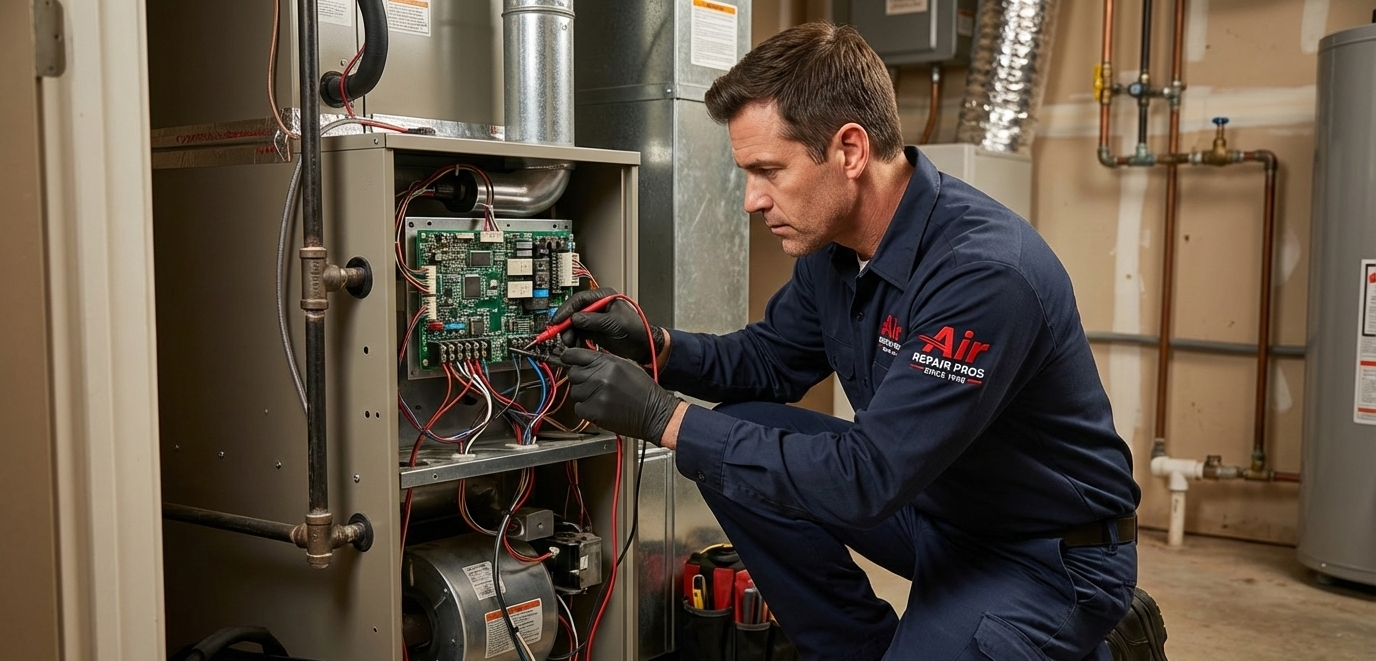
When a furnace in Frisco starts acting up in the middle of winter, the real issue isn’t always visible from the outside. Homeowners notice the heat cycling on and off, the blower running at the wrong time, or the system shutting off before the home reaches the desired temperature. What’s actually happening behind the scenes is that the control board, which manages every step of the heating cycle, has started to fail.
Once this electronic module misreads signals or sends commands out of order, the entire furnace loses coordination. Ignition becomes unreliable, airflow becomes uneven, and the furnace struggles to stay running. That’s when homeowners start looking for heating repair services in Frisco, TX, to get a precise diagnosis and restore steady warmth. The smart move is to call a trained technician who can test the control board, confirm the failure, and replace it before the furnace shuts down completely.
If the furnace is already showing signs of hesitation, don’t wait for it to quit on the coldest night of the year. A quick service call can prevent the problem from escalating and restore steady, reliable heat.
What Is a Furnace Control Board?
A furnace control board is more than a circuit board with wires. It is the command center that supervises ignition, blower speed, temperature limits, flame detection, and overall communication with the thermostat. When the thermostat calls for heat, the board decides what happens next and when. It runs the inducer motor, checks safety switches, powers the igniter, opens the gas valve, and times the blower fan.
Every primary function in the heating cycle passes through it. This is why the earliest signs of trouble often appear random at first, but they can ultimately make heater-repair services mandatory. Maybe the burners light but shut down a few seconds later. Perhaps the blower refuses to start. The furnace may work one day and fail the next.
Control boards interpret dozens of signals simultaneously, so even minor voltage fluctuations or loose wiring can disrupt the timing sequence. These disruptions often show up as symptoms of a faulty furnace control board, including:
- A furnace that refuses to start
- A blower motor that keeps running when the heat cycle is off
- Burners are igniting and immediately shutting down
- Long delays between thermostat demand and furnace startup
- Inconsistent LED diagnostic codes
- Electrical smells near the furnace panel
Common Problems of a Furnace Control Board and How an Expert Will Fix Them
Control board failures fall into a few predictable categories. Each one disrupts the heating cycle differently. Technicians see these issues every winter, especially during temperature swings when furnaces run harder than usual. Here’s how experts diagnose and repair the most common problems.
1: Blower Fan Runs Constantly
One of the most frustrating furnace issues is the blower running nonstop even after the home reaches the desired temperature. The fan won’t shut off, the rooms start feeling drafty, and energy use climbs for no reason. In many cases, the real problem is a stuck blower relay on the control board.
Diagnostic checks include:
- The G-terminal signal from the thermostat
- The board’s relay operation
- The blower motor wiring and capacitor
If the relay is welded shut or intermittently failing, the only long-term solution is to replace the HVAC control board. Relays cannot be reliably repaired in the field.
2: Furnace Ignites but Shuts Off Immediately
This is a classic timing-sequence problem. The board may not detect the flame signal even though the burners are lit. Issues like these underline the importance of verifying every connection and timing sequence during furnace installation, step by step, to ensure the system is built to avoid early failures. Faulty sensing circuits, poor flame signal interpretation, or failing components within the control board can all cause this.
The technician checks:
- Flame sensor cleanliness
- Sensor voltage and microamp reading
- Grounding path back to the board
- Wiring from the sensor to the control module
If all readings look correct but the board still misinterprets the flame, the board’s internal circuitry is failing. HVAC control board replacement becomes the safest step.
3: Furnace Fails to Start the Heating Cycle
If the inducer motor or igniter does not activate, the board may not be sending the required 120V or 24V signals. Internal logic faults, cracked solder joints, or burned components are often the cause.
The technician follows a structured diagnostic pattern:
- Confirm 120V power to the furnace
- Check transformer output for steady 24V
- Test safety switches and verify continuity
- Measure voltage outputs to the inducer and igniter
If voltage inconsistencies appear, the board is likely compromised. An expert matches the exact OEM board to ensure proper communication and heating sequence timing.
4: Random Error Codes or LED Patterns
Instead of consistent diagnostic flashes, the board may show unpredictable patterns. This often indicates internal logic corruption, unstable voltage interpretation, or deteriorating components within the control module.
To narrow down the issue, the technician works through a series of steps:
- Reset the furnace and monitor the control board’s reboot
- Confirm that the system receives a stable voltage without fluctuations
- Inspect low-voltage wiring and tighten or reseat loose connectors
- Compare LED flash patterns against the furnace’s diagnostic chart
- If codes do not match the furnace’s actual behavior, the board is identified as faulty and scheduled for replacement
If any mismatched signals or irregular behavior are detected, the control board is confirmed as the source of the problem. At that point, a technician selects the correct OEM replacement to restore proper communication, timing, and safe furnace operation.
5. Burning Smell or Visible Damage
Heat stress, rapid cycling, moisture exposure, or electrical surges can scorch the control board. Melted connectors, bubbled coating, or darkened terminals are visible signs of internal overheating.
The careful inspection sequence would be:
- Remove power and inspect the control board for burnt marks or melted areas
- Check nearby wiring harnesses for heat damage
- Verify that no short circuits or loose connections contributed to the failure
- Install a new OEM-matched control board since damaged boards cannot be repaired safely
- Recheck the system wiring to prevent the same issue from recurring
If the inspection reveals any burnt components or wiring damage, the control board is deemed unsafe to reuse. A technician then installs a properly matched OEM board and verifies that all connections are secure, restoring safe operation and preventing the issue from recurring.
6. Delayed Response Between Thermostat and Furnace
The control board interprets every thermostat signal. If the furnace responds slowly or inconsistently, the board may be misreading or delaying those commands.
The technician will narrow the issue down with targeted checks:
- Confirm voltage stability at the board’s low-voltage terminals
- Inspect connectors for corrosion or loose fits
- If the thermostat sends correct signals but the board delays response, the technician replaces the control board
If everything upstream checks out, but the control board still responds slowly or incorrectly, the technician confirms the board as the failing component and installs an OEM replacement to restore accurate heating responses.
A reliable heating system repair guide exists for one reason: to help homeowners understand the steps technicians follow when diagnosing furnace problems. It breaks down the process so the issue feels less mysterious and more manageable. When the basics check out, but the furnace still behaves erratically, the control board is the prime suspect.
Final Thoughts!
A damaged control board can leave a home cold, create frustrating symptoms, and drain energy efficiency. When symptoms of a faulty furnace control board appear, such as constant fan operation, shutdowns, ignition failures, or unpredictable behavior, the safest choice is to work with trusted heat repair services in Frisco, TX, who understand modern furnace electronics.
Air Repair Pros stands out because of skilled diagnostics, fast service, and transparent explanations. The team doesn’t just swap parts; we identify root causes, protect the rest of the system, and guide homeowners with solutions that last. Our technicians understand Frisco’s weather patterns.Homeowners in Frisco, TX, who need dependable heat repair services can contact the HVAC experts at Air Repair Pros via the website to schedule service. Our team is ready to restore heat, improve furnace reliability, and keep homes comfortable all season long.