

Tankless vs. Tank Water Heater in Plano, TX: What Homeowners Need to Know
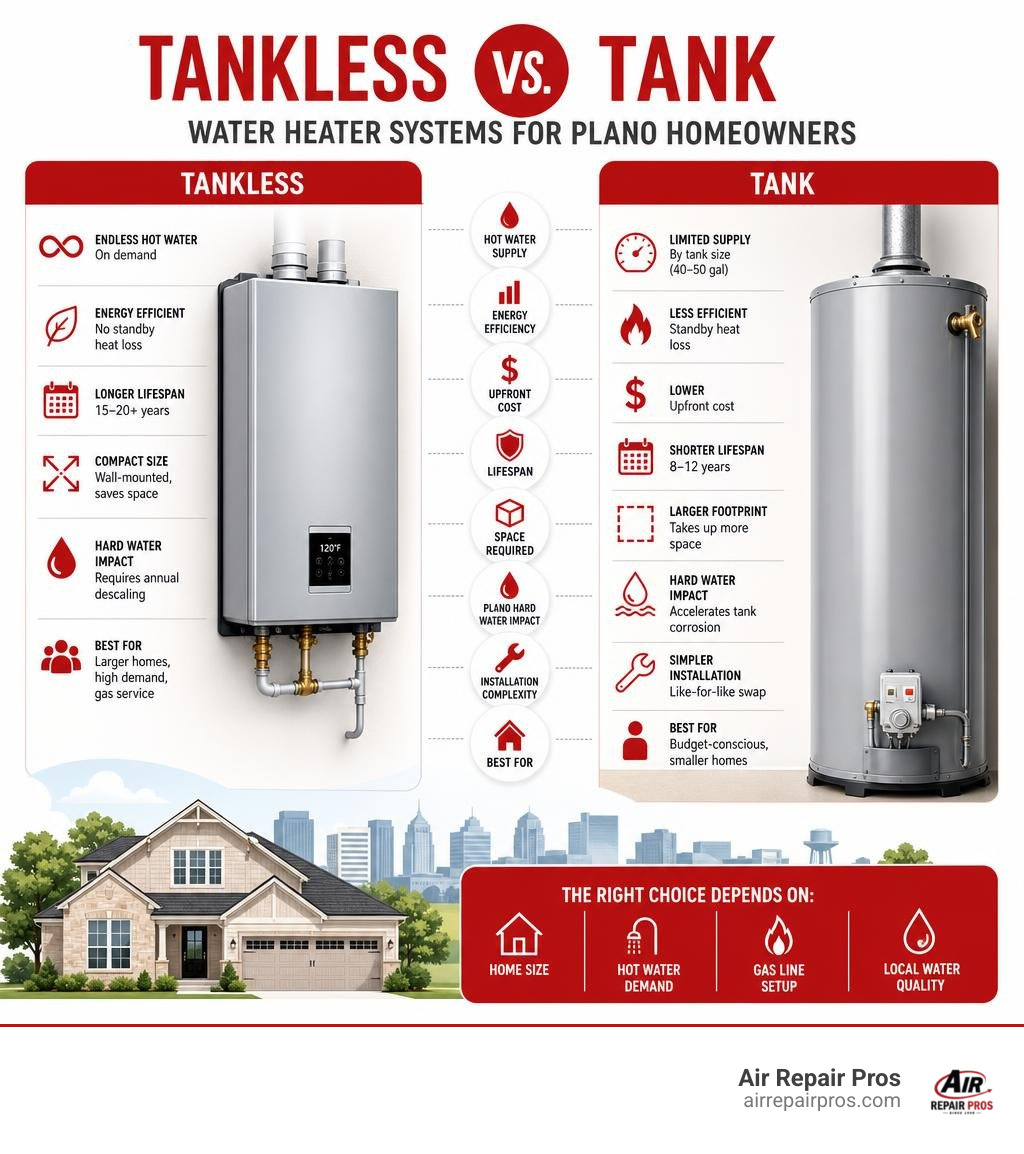
When weighing a tankless vs tank water heater Plano TX decision, the right answer depends on your home’s size, hot water demand, gas line setup, and local water quality, not just the price tag.
Here’s a quick breakdown to help you decide:
| Factor | Tankless Water Heater | Tank Water Heater |
|---|---|---|
| Hot water supply | Continuous, on demand | Limited by tank size (40-50 gal) |
| Energy efficiency | 24-34% more efficient | Loses energy to standby heat loss |
| Upfront cost | Higher | Lower |
| Lifespan | 15-20+ years | 8-12 years |
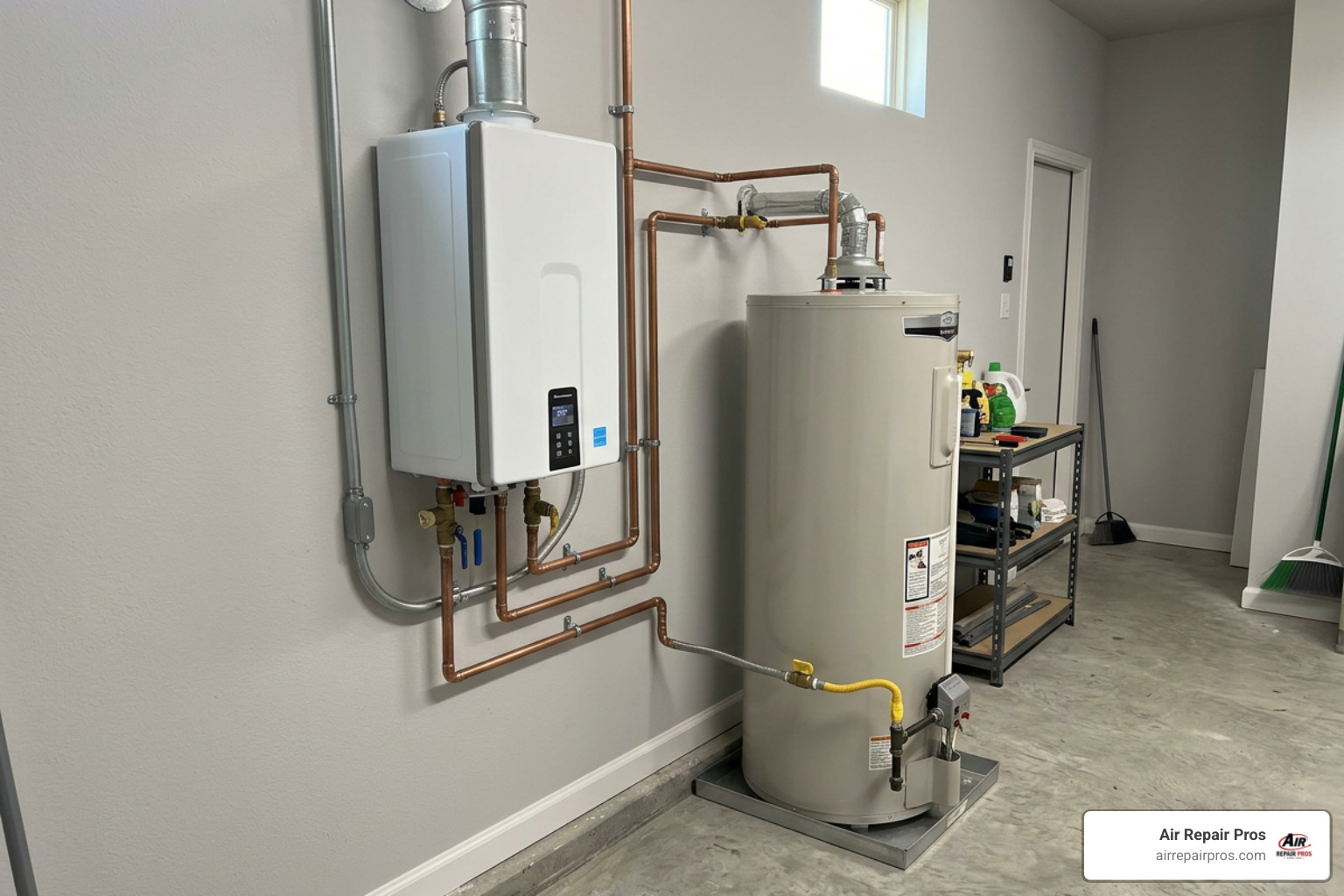
| Space required | Compact, wall-mounted | Larger footprint |
| Plano hard water impact | Requires annual descaling | Accelerates tank corrosion |
| Installation complexity | May need gas line or venting upgrades | Simpler, like-for-like swap |
| Best for | Larger homes, high demand, gas service | Budget-conscious, smaller homes |
Plano homeowners face a specific set of conditions that make this decision more nuanced than most national guides suggest. The city’s moderately hard water, North Texas heat, and the large floor plans common in neighborhoods across the area all play a role in which system will serve you best over the long run.
Think about the Wilson family in Plano, standing in their garage staring at a rusted, 15-year-old tank water heater after weeks of cold showers mid-shower. That moment captures exactly why so many local homeowners are asking this question right now.
This guide from Air Repair Pros breaks down everything you need to make a confident, informed choice, from installation costs and energy savings to hard water maintenance and local code requirements.
Comparing Tankless vs Tank Water Heater Plano TX Systems
To make the right choice for your household, it helps to understand how these two technologies handle your daily hot water needs. Traditional tank water heaters have been the standard in North Texas for decades. They work by keeping a large volume of water, usually forty to fifty gallons, constantly heated in a storage tank. This design means hot water is always ready to go, but it also leads to standby heat loss. The burner or heating element must cycle on and off repeatedly to keep that water hot, even when you are asleep or away at work.
Tankless water heaters, on the other hand, do not store hot water. Instead, they heat water on demand. When you turn on a hot water faucet, cold water flows into the unit, where a powerful gas burner or electric element instantly heats it to your target temperature. This process eliminates standby heat loss entirely, making tankless units highly energy-efficient.
However, the best system for your home depends on your unique usage patterns. While a traditional tank can deliver a massive volume of hot water all at once, it will eventually run out, leaving the next person in line with a chilly surprise. A tankless system provides a continuous stream of hot water that never runs out, but its delivery is limited by how much water it can heat at one single moment. Understanding these operational differences is the first step in selecting the right option among modern water heaters for your home.
Sizing and Flow Rate for Tankless vs Tank Water Heater Plano TX Units
When sizing a water heater for a home in Plano, TX, we measure traditional tanks by their storage volume, while tankless systems are rated by gallons per minute (GPM). Sizing a tankless unit requires looking at two main factors: your household’s peak simultaneous hot water demand and the incoming groundwater temperature.
In North Texas, our groundwater temperature averages around 60 to 70 degrees Fahrenheit. Because our groundwater is warmer than in northern states, a tankless unit does not have to work quite as hard to raise the water to a comfortable showering temperature. This regional advantage means a single tankless unit can often support multiple fixtures at the same time in a typical Plano household.
To determine the right GPM for your home, you must consider simultaneous fixture use. For example, if you want to run a hot shower, the dishwasher, and a washing machine all at the same time, your tankless unit will need a higher GPM rating. If the system is undersized, you may experience a drop in water pressure or temperature when multiple taps are open. Consulting a professional for a precise calculation ensures your new tankless water heater installation meets your family’s real-world needs.
Lifespan and Long-Term Durability
A water heater is a major home investment, so equipment longevity is a primary consideration. Traditional tank water heaters typically last between eight and twelve years in the North Texas region. Over time, the constant exposure to water causes the steel tank to corrode. While tank systems include a sacrificial anode rod designed to attract corrosive elements, once this rod degrades, the tank itself begins to rust, eventually leading to leaks or complete tank failure.
Tankless water heaters offer superior durability, often lasting twenty years or more with proper care. Because they do not store water, they are not subject to the same constant corrosion risks as traditional tanks. Components inside a tankless unit are also individually replaceable, meaning a single failed part does not necessarily require replacing the entire system. This longer lifespan can be especially helpful for homeowners comparing replacement timing, energy savings, and ongoing maintenance over the next decade.
For homeowners planning seasonal maintenance or weighing a tankless upgrade, Air Repair Pros offers practical guidance on water heater care, HVAC performance, plumbing reliability, and everyday comfort for homes in Frisco, TX, McKinney, TX, Plano, TX, Little Elm, TX, and Allen, TX.
Performance, Comfort, and Everyday Usability
From a daily comfort perspective, the choice between tank and tankless comes down to how your family uses water. If you have a large household with back-to-back morning showers, a tankless system provides the ultimate luxury: endless hot water. You will never have to worry about being the last person to use the shower.
However, tankless systems can occasionally introduce minor performance quirks, such as the cold water sandwich effect. This occurs when a hot water tap is turned on, off, and then quickly back on again. A brief pocket of cold water that was left in the plumbing line between uses travels to the faucet before the burner can fully reignite and heat the new incoming water.
Fortunately, professional plumbing technicians can easily resolve this issue. By installing a dedicated recirculation pump, hot water can circulate continuously through your plumbing lines. This setup delivers hot water to your taps almost instantly, eliminating both the cold water sandwich and the wait time for hot water to reach distant bathrooms. If you ever experience temperature fluctuations or performance issues, timely maintenance and repair can keep your system running smoothly.
Space Savings and Installation Flexibility
Another major benefit of tankless water heaters is their highly compact design. Traditional tank heaters are bulky, occupying a significant footprint in your garage, utility closet, or attic. For Plano homeowners looking to maximize storage space or free up room in the garage for a larger vehicle, switching to a tankless unit is an excellent solution.
Tankless water heaters are roughly the size of a suitcase and are mounted directly to the wall. This compact footprint provides incredible installation flexibility. They can be installed in tight closets, pantries, or even on the exterior of your home in some configurations, provided they are properly insulated against occasional winter freezes. Keeping up with regular maintenance will ensure that, regardless of where your unit is installed, it remains safe and efficient year-round.
Financial Considerations: Upfront Costs vs. Long-Term Savings
When deciding between a tankless and a traditional water heater, it is important to balance the initial purchase and installation costs against the long-term savings on your monthly utility bills. While a traditional tank system is more affordable upfront, a tankless system can significantly reduce your operating costs over its lifespan.
According to the Department of Energy, water heating is the second-largest energy expense in most homes. By eliminating standby energy loss, tankless units operate with much higher energy factors, helping homeowners lower their monthly energy consumption.
Upfront Installation and Infrastructure Upgrades
The higher upfront cost of a tankless water heater is largely due to the installation complexity and the infrastructure upgrades required to support the unit. Unlike a straightforward, like-for-like tank replacement, installing a tankless system for the first time often requires modifying your home’s existing utility lines.
- Venting Requirements: Gas tankless units require specialized Category III or IV stainless steel or concentric venting to safely exhaust high-temperature combustion gases.
- Gas Line Resizing: Tankless units burn gas at a much higher rate than traditional tanks to heat water instantly. This means your existing gas line may need to be upsized from a half-inch to a three-quarter-inch line.
- Electrical Panel Capacity: Electric tankless models draw a significant amount of electricity, often requiring multiple dedicated circuits and an upgrade to a larger electrical panel.
Because of these technical requirements, it is essential to hire certified professionals for installation, especially when the project involves gas service, venting changes, or electrical upgrades.
Energy Efficiency and Monthly Utility Savings
Once installed, a tankless water heater begins to pay dividends through reduced energy consumption. Because the system only heats water when a faucet is turned on, you are no longer paying to keep forty or fifty gallons of water hot all day and night.
These efficiency gains are even more pronounced when you select Energy Star certified water heaters, which meet strict efficiency guidelines set by the government. Over the twenty-year lifespan of a tankless unit, the monthly utility savings, combined with the system’s exceptional durability, often make it a highly cost-effective investment for long-term homeowners.
Local Plano, TX Environmental and Infrastructure Factors
Plano homeowners must navigate unique local environmental factors that directly affect water heater performance and longevity. The municipal water supply and our North Texas climate both play crucial roles in how your system operates over time. Working with a local expert who understands the specific needs of the Plano community is the best way to protect your investment.
Impact of Plano Hard Water on Water Heaters
One of the most significant challenges for water heaters in Plano is hard water. The local water supply contains elevated levels of dissolved minerals, primarily calcium and magnesium. When hard water is heated, these minerals precipitate out of the water and form a hard crust of scale inside your plumbing appliances.
In a traditional tank heater, this mineral scale settles to the bottom of the tank, creating an insulating layer between the burner and the water. This forces the system to run longer and hotter to heat the water, accelerating tank failure. In a tankless unit, scale builds up inside the copper heat exchanger, restricting water flow and reducing heating efficiency.
To prevent scale from damaging your system, annual descaling maintenance is highly recommended. This process involves flushing the heat exchanger with a food-grade descaling solution to dissolve the mineral buildup. For ultimate peace of mind, pairing your water heater with a whole-home water softener can dramatically extend the lifespan of your appliance. Keeping up with professional maintenance is the key to preventing hard water from cutting your system’s life short.
Local Building Codes and Permit Requirements
In Plano, TX, installing or replacing a water heater is not a simple do-it-yourself project. The city requires a plumbing permit and a post-installation safety inspection for all water heater installations. These local building codes are in place to protect your family and your property.
Safety standards cover critical elements such as proper gas line connections, adequate combustion air venting, the installation of an expansion tank, and the placement of a temperature and pressure relief valve. Utilizing a licensed, professional plumbing company ensures that your installation meets all local codes and passes municipal inspection without any costly delays. If you ever suspect an issue with your system’s compliance or safety, scheduling prompt service is the safest course of action.
Frequently Asked Questions about Water Heaters
What is the average cost difference for a tankless vs tank water heater Plano TX installation?
A tankless water heater installation generally carries a higher upfront cost than a traditional tank replacement. This difference is due to the advanced technology of the tankless unit and the infrastructure upgrades required, such as gas line resizing, advanced venting, or electrical panel modifications. Homeowners should request a professional estimate to understand the exact costs for their specific home setup.
How does Plano hard water affect tankless and tank water heaters?
Plano’s hard water contains minerals that create scale buildup when heated. In traditional tanks, scale settles at the bottom, reducing heating efficiency and leading to tank damage. In tankless units, scale accumulates inside the narrow passages of the heat exchanger, which can cause overheating and system errors if the unit is not flushed regularly.
Do tankless water heaters really provide endless hot water?
Yes, a properly sized tankless water heater can provide continuous hot water because it heats the water on demand as it flows through the unit. However, the system must be correctly sized to handle the flow rate of all fixtures running at the same time to prevent temperature drops.
How long do tankless water heaters last compared to traditional tanks?
With proper maintenance, a high-quality tankless water heater can last twenty years or more. In contrast, traditional tank water heaters in the Plano area typically have a lifespan of eight to twelve years, largely due to internal tank corrosion caused by hard water.
What are the venting and gas line requirements for a tankless upgrade?
Gas-powered tankless units require specialized Category III or IV stainless steel or concentric venting to safely manage high-temperature exhaust. They also require more gas power instantly than standard tanks, meaning your home’s gas line may need to be upgraded to a larger diameter.
Can my existing electrical panel support an electric tankless water heater?
Electric tankless water heaters have high electrical demands, often requiring two to four dedicated double-pole breakers. Many older homes with standard electrical panels may require a service upgrade to support the added load of a whole-home electric tankless unit.
How often do tankless water heaters require maintenance and descaling?
In Plano, where the water is moderately hard, tankless water heaters should be professionally flushed and descaled at least once a year. If your home has a whole-house water softener, you may be able to extend this maintenance interval.
Does installing a tankless water heater lower home insurance premiums?
Some insurance companies offer discounts or premium reductions for homes with tankless water heaters. Because tankless units do not store forty to fifty gallons of water, they pose a significantly lower risk of catastrophic water damage from a ruptured tank.
How long does it take to install a tankless water heater versus a tank unit?
Replacing a traditional tank water heater with a similar model is usually a straightforward job that takes a few hours. Upgrading from a tank to a tankless system is more complex and can take anywhere from a half-day to a full day, depending on the extent of the gas line, venting, or electrical upgrades needed.
Are there local rebates or tax incentives for upgrading to a tankless water heater in Plano, TX?
Yes, many energy-efficient tankless water heaters qualify for federal tax credits. Additionally, local utility providers occasionally offer rebates for homeowners who upgrade to high-efficiency gas or electric water heating systems.
Conclusion
Choosing between a tankless vs tank water heater Plano TX system ultimately comes down to your family’s daily lifestyle, long-term plans, and budget. While a traditional tank water heater offers a reliable and cost-effective upfront solution, a modern tankless system provides unmatched comfort, space savings, and long-term energy efficiency that can elevate your home’s value for decades.
No matter which system you choose, the key to a safe, efficient, and long-lasting installation is working with experienced professionals. Air Repair Pros has been serving North Dallas communities, including Frisco, TX, McKinney, TX, Plano, TX, Little Elm, TX, and Allen, TX, since 1998. Our certified technicians arrive in fully stocked trucks carrying a wide variety of parts to ensure we can complete your service promptly.
Whether you are ready to upgrade to a state-of-the-art tankless system or need reliable maintenance for your existing water heater, we are here to help twenty-four hours a day, seven days a week. To explore your options or schedule a professional estimate, contact our professional water heater technicians at Air Repair Pros today.