Get Your Little Elm, TX HVAC System Ready for Fall
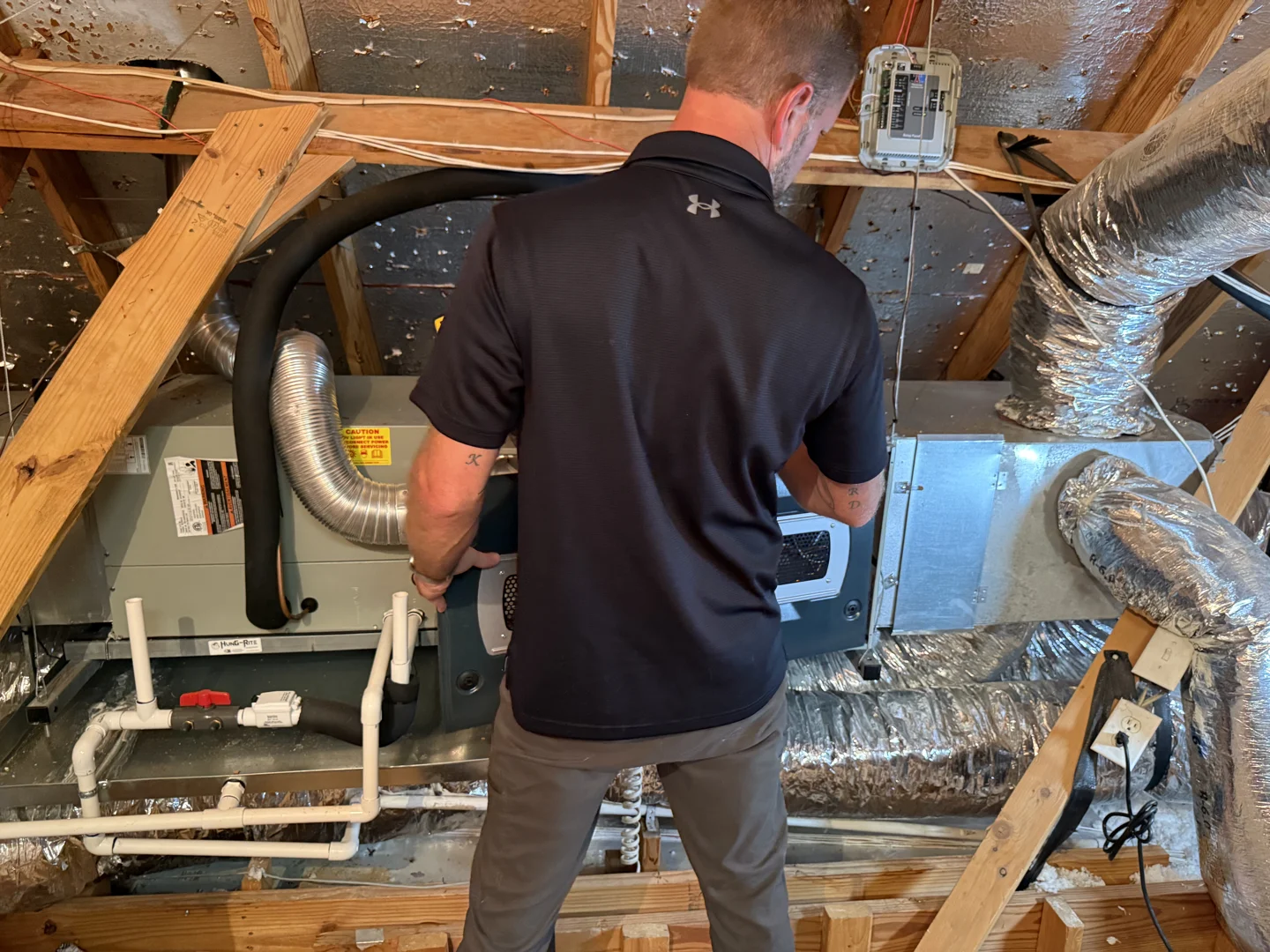
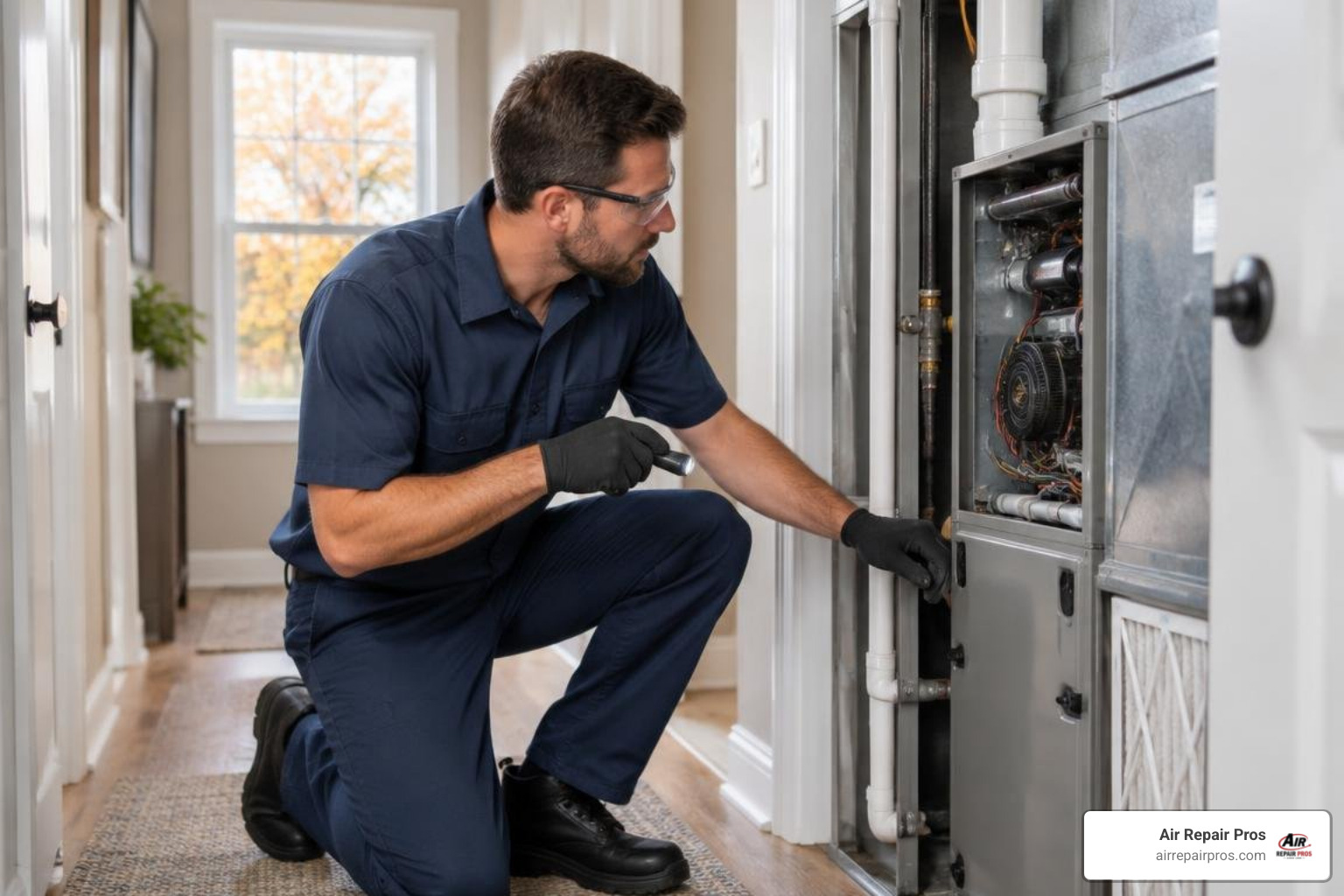
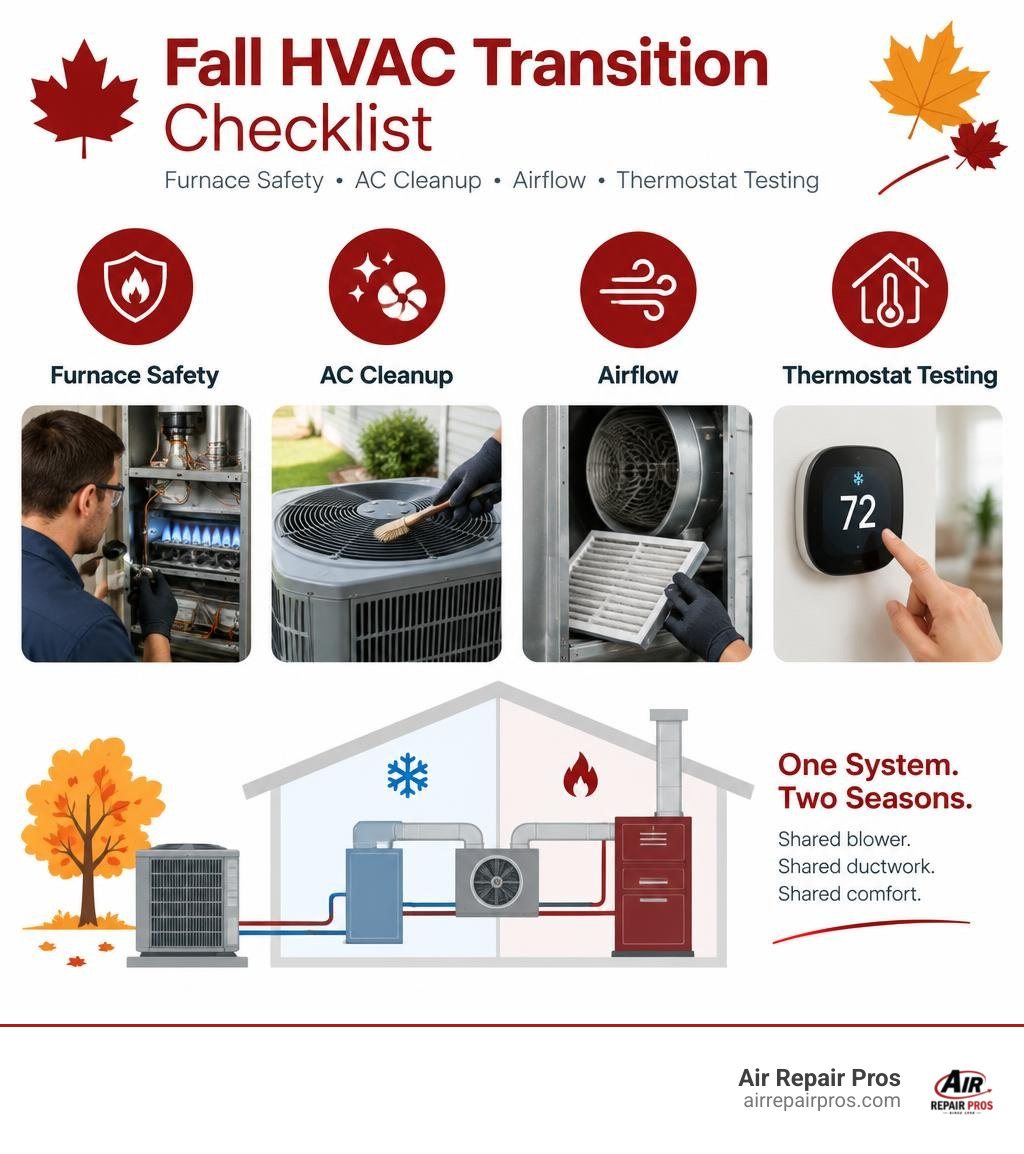
Schedule a combined furnace AC tune up in early fall to prepare both sides of your HVAC system for the season ahead. A qualified technician should inspect furnace safety controls and combustion, clean and test airflow components, check the thermostat, and review the AC equipment after a long North Texas summer.
For Little Elm, TX homeowners, this service helps catch small issues before the first cold night or the next warm spell. It also supports steadier comfort, cleaner airflow, and fewer surprise breakdowns from the shared blower, ductwork, and electrical components your furnace and AC use.
A proper visit is more than a quick look. It should include meaningful safety and performance checks, such as filter condition, blower operation, heat exchanger inspection, gas and carbon monoxide testing for gas furnaces, and condensate drain and outdoor-unit checks for the AC.
Air Repair Pros can help you move into fall with a system that is clean, tested, and ready to work when North Texas weather changes.
1. Why a Combined Furnace AC Tune Up Is Essential for Little Elm Homes
Living in Little Elm, TX means dealing with rapid weather swings throughout the autumn months. A crisp morning in October can easily climb into the mid-80s by late afternoon, forcing your home comfort equipment to alternate between heating and cooling in a single 24-hour cycle. Because split HVAC systems share key hardware across both heating and cooling modes, servicing only half of the system leaves your home vulnerable to sudden breakdowns.
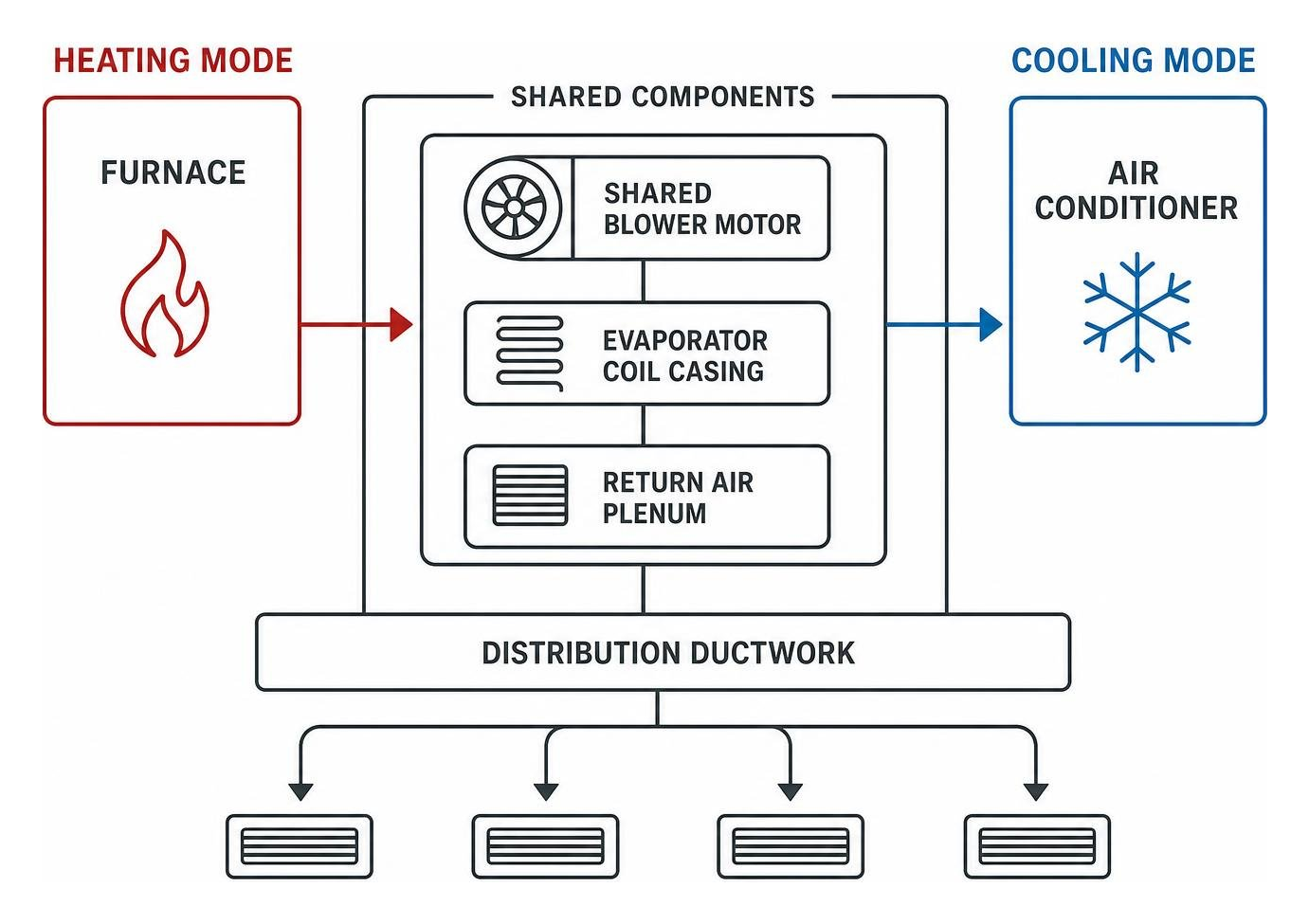
The heart of your indoor setup contains components that work year-round. The blower motor, blower wheel, evaporator coil casing, return air plenum, and distribution ductwork run constantly whether you are calling for warm air or crisp air conditioning. When you book comprehensive HVAC maintenance, technicians inspect the complete operational loop to ensure seamless transitions between modes.
Addressing both heating and cooling equipment simultaneously delivers significant benefits:
- Eliminates residual summer stress on electrical contactors and capacitors before winter loads begin
- Clears accumulated dust and biological growth from the indoor coil before turning on high-heat burners
- Verifies that shared safety switches, limit controls, and condensate overflow sensors trigger properly
- Ensures optimal static pressure throughout the duct system to balance airflow to every room
Maximizing Energy Efficiency With a Furnace AC Tune Up
A neglected HVAC system gradually loses operating efficiency as dust blankets critical internal surfaces and electrical connections degrade. In fact, standard industry technical reference models assume residential heating and cooling systems operate roughly 5,840 hours per year across combined cycles. During peak Texas cooling and heating periods, system performance directly correlates with the peak coincidence factor, which measures how hard your equipment strains against grid demand.
When dirt accumulates on the blower wheel or gas burners fall out of calibration, the system draws higher electrical current and burns more fuel to deliver the same indoor temperature. Routine maintenance restores factory-specified airflow and fuel consumption metrics. By maintaining your equipment each September, you can expect an efficiency improvement of 5% to 15%, which directly delivers lower utility bills throughout the season. Homeowners seeking ways to lower operational costs often discover that a professional visit pays for itself through steady power conservation, as detailed in our guide on how an HVAC tune-up reduces costs.
Protecting Equipment Longevity and Warranty Compliance
Residential heating and cooling setups represent a major home investment designed to last 12 to 15 years with proper care. However, skipping seasonal maintenance is the leading cause of premature component failure, turning a manageable tune-up into an expensive emergency replacement.
Every major HVAC equipment manufacturer requires documented annual maintenance by certified technicians to keep factory parts warranties valid. If an expensive component like a compressor or heat exchanger fails, manufacturers routinely ask for historical maintenance records before approving warranty claims. Investing in seasonal heating system maintenance protects this warranty protection while shielding major mechanical parts from unnecessary stress.
2. Complete Fall Furnace Maintenance Checklist: What Technicians Inspect
A true heating tune-up requires rigorous scientific testing rather than a casual visual glance. Technicians adhere to industry guidelines, such as those established by the Air Conditioning Contractors of America, to measure system performance against strict manufacturer ratings.
Critical Combustion and Safety Checks
Gas furnaces rely on controlled combustion to produce warmth. If any stage of the ignition, burning, or venting process fails, hazardous gases can leak into the indoor air supply.
During a professional fall tune-up, technicians perform vital safety evaluations:
- Heat Exchanger Integrity Inspection: The technician inspects the primary and secondary heat exchangers for microscopic stress fractures, corrosion, or metal fatigue using high-resolution inspection cameras. Cracked heat exchangers allow toxic flue gases to mix directly with the indoor breathing air.
- Carbon Monoxide (CO) Testing: Testing occurs in three distinct zones: ambient air in the living spaces (target: 0 ppm), ambient air near the furnace cabinet (target: under 9 ppm), and inside the flue exhaust pipe (target: under 100 ppm air-free CO).
- Inlet and Manifold Gas Pressure: Natural gas pressures must match the manufacturer rating plate, generally requiring 4.5 to 10.0 inches of water column (in. w.c.) for inlet supply and 3.2 to 3.8 in. w.c. at the burner manifold.
- Flame Sensor Microamp Verification: Flame rectification circuits require consistent electrical flow to prove a stable flame exists. Clean sensors generate between 2.0 and 6.0 microamps (µA); readings dropping below 1.0 µA trigger automated safety lockouts.
- Igniter Resistance and Limit Switch Operation: Technicians test the resistance of hot surface igniters and verify high-limit safety switches open and close properly to prevent furnace overheating.
Airflow and Electrical Component Testing
Proper airflow is vital for balanced heat exchange and motor health. Without adequate air movement across the furnace cabinet, internal temperatures climb dangerously high, causing the system to short cycle on its high-limit switch.
Technicians carefully test airflow and electrical components during this visit:
- Static Pressure Measurement: Total external static pressure is measured before and after the air filter to evaluate duct resistance and blower wheel performance.
- Temperature Rise Calculation: The technician measures the temperature difference between the return air duct and supply plenum, confirming it falls within the specified range (typically 45°F to 75°F for gas furnaces).
- Blower Motor Amperage and Capacitor Ratings: Technicians measure running amperage against rated full load amps (FLA) and test motor capacitors to verify they fall within a 5% to 10% tolerance range.
- Blower Assembly Deep Cleaning: Dust buildup on curved blower blades reduces air velocity; wiping down the blades restores airflow and protects the motor bearings.
Homeowners can review our furnace tune-up checklist to see how these electrical and airflow assessments protect overall system performance.
3. Post-Summer Air Conditioning Checklist Before Winter Shutdown
While fall puts the focus on heating safety, proper care for your cooling system before cold weather sets in protects outdoor components from winter damage and prevents acid buildup in the refrigerant circuit.
Preparing the Outdoor Condenser and Reversing Valve
The outdoor condenser unit takes the brunt of summer heat waves in North Texas. By late September, condenser fins are often coated in dirt, yard debris, and grass clippings that restrict airflow.
During the cooling portion of the service, technicians carry out several key steps:
- Coil Cleaning and Fin Straightening: Technicians wash the condenser coils using safe, low-pressure methods to clear away summer grime, straightening bent aluminum fins to restore heat rejection capacity.
- Debris Clearance and Cabinet Inspection: Technicians ensure a minimum 24-inch clearance around the outdoor unit, clearing leaves, twigs, and overgrown vegetation.
- Electrical Contactor and Relay Testing: Heavy summer cycling causes pitting and oxidation on electrical contact points; catching worn contacts early prevents compressor startup failures.
- Heat Pump Reversing Valve Verification: For heat pump configurations, technicians test the reversing valve solenoid to ensure the unit switches smoothly from cooling mode into winter defrost and heating modes.
Evaporator Coil and Condensate Drain Line Service
High humidity levels during summer force the AC evaporator coil to extract gallons of water from your indoor air every day. As moisture drains through the system, dust and algae accumulate inside the drain pan and piping.
Technicians provide critical evaporator drain maintenance:
- Clearing the Primary Condensate Line: The line is flushed and cleared using specialized vacuum tools or nitrogen to eliminate standing water, sludge, and algae buildup.
- Testing Float Switches and Safety Shutoffs: Technicians test the emergency float switch to confirm that the HVAC system will shut down safely if a drain line clogs, protecting ceilings and floors from water damage.
- Evaporator Coil Inspection: Technicians examine the indoor coil for biological growth or corrosion along the copper refrigerant joints.
Our 17-point AC tune-up checklist explains the inspection points that help identify cooling-system issues before the next heavy-use season.
Regular AC maintenance gives the Air Repair Pros team an opportunity to inspect the outdoor unit, condensate system, and shared indoor components before winter.
4. Step-by-Step Homeowner Prep vs. Professional Service
Homeowners can manage several simple maintenance tasks between professional visits, but complex electrical and combustion procedures should always be left to certified technicians.
Safety Warning: High-voltage electrical connections, natural gas lines, and high-pressure refrigerants present severe hazards. Homeowners should never open electrical disconnect boxes, dismantle gas valves, or reach inside blower assemblies while power is connected.
| Maintenance Task | Homeowner DIY Scope | Professional Technician Scope |
|---|---|---|
| Air Filtration | Inspect and replace 1-inch to 4-inch filters every 30 to 90 days. | Measure static pressure drop across the filter media and check cabinet seals. |
| Air Vents and Registers | Keep all supply and return vents unobstructed by furniture and rugs. | Measure airflow CFM balance and check duct distribution runs. |
| Outdoor Unit Clearance | Clear fallen leaves and trim shrubs to maintain 2 feet of space. | Deep wash coils, check fan motor bearings, and test compressor run capacitors. |
| Thermostat Calibration | Replace backup batteries and program seasonal heating schedules. | Test temperature sensor calibration, anticipator settings, and subbase wiring. |
| Condensate Management | Pour a cup of distilled white vinegar into the drain line access port twice a year. | Flush drain lines, test secondary overflow safety switches, and inspect drain pan. |
| Combustion System | Keep the area around the furnace clear of flammable storage and paints. | Perform combustion analysis, adjust gas manifold pressure, and clean burners. |
| Heat Exchanger & CO | Test and replace batteries in wall-mounted home carbon monoxide detectors. | Inspect heat exchanger with cameras and measure carbon monoxide in flue exhaust. |
Key Steps in a Professional Furnace AC Tune Up Visit
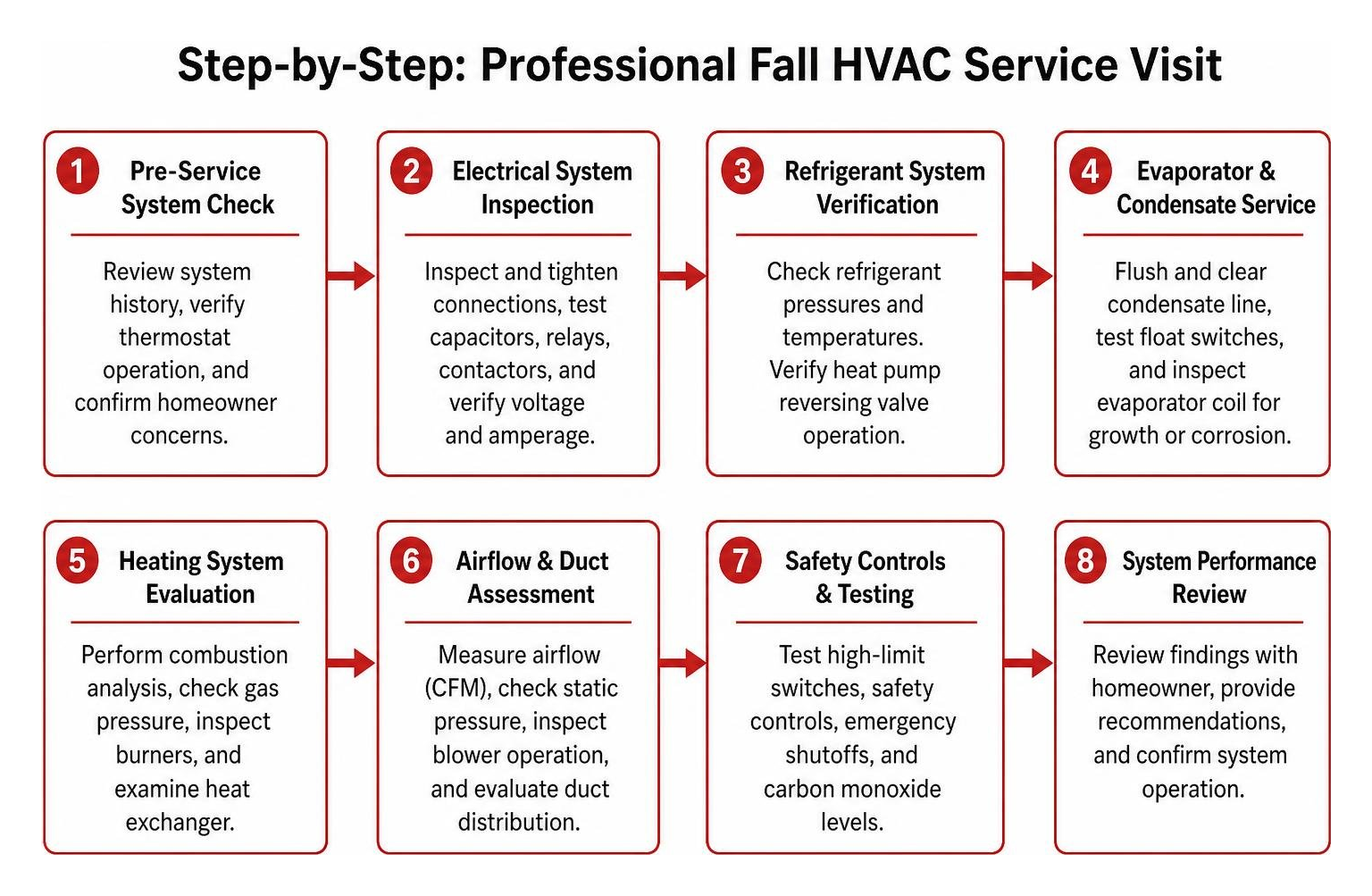
A comprehensive HVAC maintenance appointment lasts between 60 and 90 minutes per system. During this visit, technicians follow a methodical process:
- Initial System Diagnosis: The technician powers on the heating and cooling cycles, listening for abnormal motor bearing friction, inducer motor vibration, or delayed ignition noises.
- Electrical and Mechanical Cleaning: Technicians clean the flame sensor rod, vacuum dust out of the burner compartment, clear debris from the control board housing, and inspect wiring harnesses for heat wear.
- Safety and Precision Calibration: The technician attaches digital pressure gauges to verify gas manifold pressure and conducts a digital combustion analysis after running the furnace for ten minutes.
- Documentation and Findings Report: Homeowners receive a written diagnostic report showing exact electrical amp draws, temperature rise numbers, and combustion readings.
Following a thorough winter readiness checklist ensures your system operates reliably throughout the cold months ahead.
Frequently Asked Questions About HVAC Maintenance
What is included in a furnace AC tune up?
A combined tune-up includes a complete safety and operational inspection of both heating and cooling components. Technicians test gas pressures, clean burners, inspect the heat exchanger, test the flame sensor, clear the AC condensate line, inspect electrical contactors, test motor capacitors, clean the blower assembly, and test the thermostat for accurate calibration.
How often should a furnace and AC system be serviced?
An HVAC system should be professionally serviced twice per year. The heating system requires a dedicated tune-up in late summer or early fall before cold weather arrives, while the cooling system should be serviced in the spring before heavy summer temperatures begin.
How long does a combined heating and cooling tune-up take?
A thorough combined tune-up for a single split system takes between 60 and 90 minutes. Homes with multiple HVAC units require an additional 45 to 60 minutes per additional system to allow enough time for electrical testing, combustion analysis, and safety checks.
How much does a standard furnace AC tune-up cost in 2026?
The cost of an HVAC tune-up generally falls within a standard service range depending on the complexity of the equipment and whether the homeowner participates in an ongoing maintenance plan. Membership plans often provide bundled pricing for dual-season visits along with repair discounts and waived emergency fees.
What is a safe carbon monoxide reading during a furnace check?
A safe carbon monoxide reading is 0 parts per million (ppm) within indoor living spaces and less than 9 ppm in the immediate area around the furnace cabinet. Inside the exhaust flue pipe, technicians verify that air-free carbon monoxide levels remain well below 100 ppm during active combustion.
Can skipping annual maintenance void my HVAC manufacturer warranty?
Yes. Nearly all HVAC equipment manufacturers state in their warranty terms that regular annual maintenance by a licensed contractor is required to keep parts coverage active. If a major part fails, the manufacturer may require documentation showing regular maintenance before covering the replacement cost.
Does a furnace tune-up always require a combustion analysis?
Yes, a professional furnace tune-up on a gas-fired heating system should always include a combustion analysis. Industry standards, including ACCA Standard 4, specify combustion testing to evaluate fuel efficiency, identify drafting problems, and detect hidden blockages in the secondary heat exchanger.
Why should I service my AC in the fall along with the furnace?
Servicing the AC in early fall lets technicians clean away summer dirt from the outdoor condenser coils, clear corrosive organic buildup from the condensate drain pan, check refrigerant circuits before winter dormancy, and inspect shared air handler components that operate across both seasons.
Should the furnace flame sensor be replaced during every tune-up?
No, a flame sensor does not need to be replaced every year. In most cases, gently cleaning oxidation off the metal sensor rod with an abrasive pad restores normal operation. Replacement is only needed if the sensor is physically damaged or if electrical readings stay below 1.0 microamp after cleaning.
What are the signs that my system needs an immediate repair rather than a tune-up?
A system needs immediate diagnostic repair if you notice a yellow or flickering burner flame, loud grinding or screeching mechanical noises, burning electrical odors, persistent short cycling, water pooling around the indoor unit, or a complete lack of warm airflow during a heating cycle.
Conclusion: Schedule Your Little Elm Fall HVAC Service Today
Taking the time to schedule seasonal maintenance before winter arrives protects your equipment, keeps your energy bills low, and keeps your family safe and comfortable all season long. With fully stocked service vehicles carrying over 85% of standard replacement parts, the certified technicians at Air Repair Pros are equipped to complete your maintenance and handle minor repairs in a single visit. Whether you need a comprehensive seasonal inspection or urgent heating repair, our team provides dependable service across Little Elm, TX, Frisco, TX, Plano, TX, McKinney, TX, and Allen, TX. Please contact our heating maintenance specialists today to book your fall tune-up and keep your home comfortable throughout the cooler months.