
What to Do When Your AC Is Blowing Warm Air
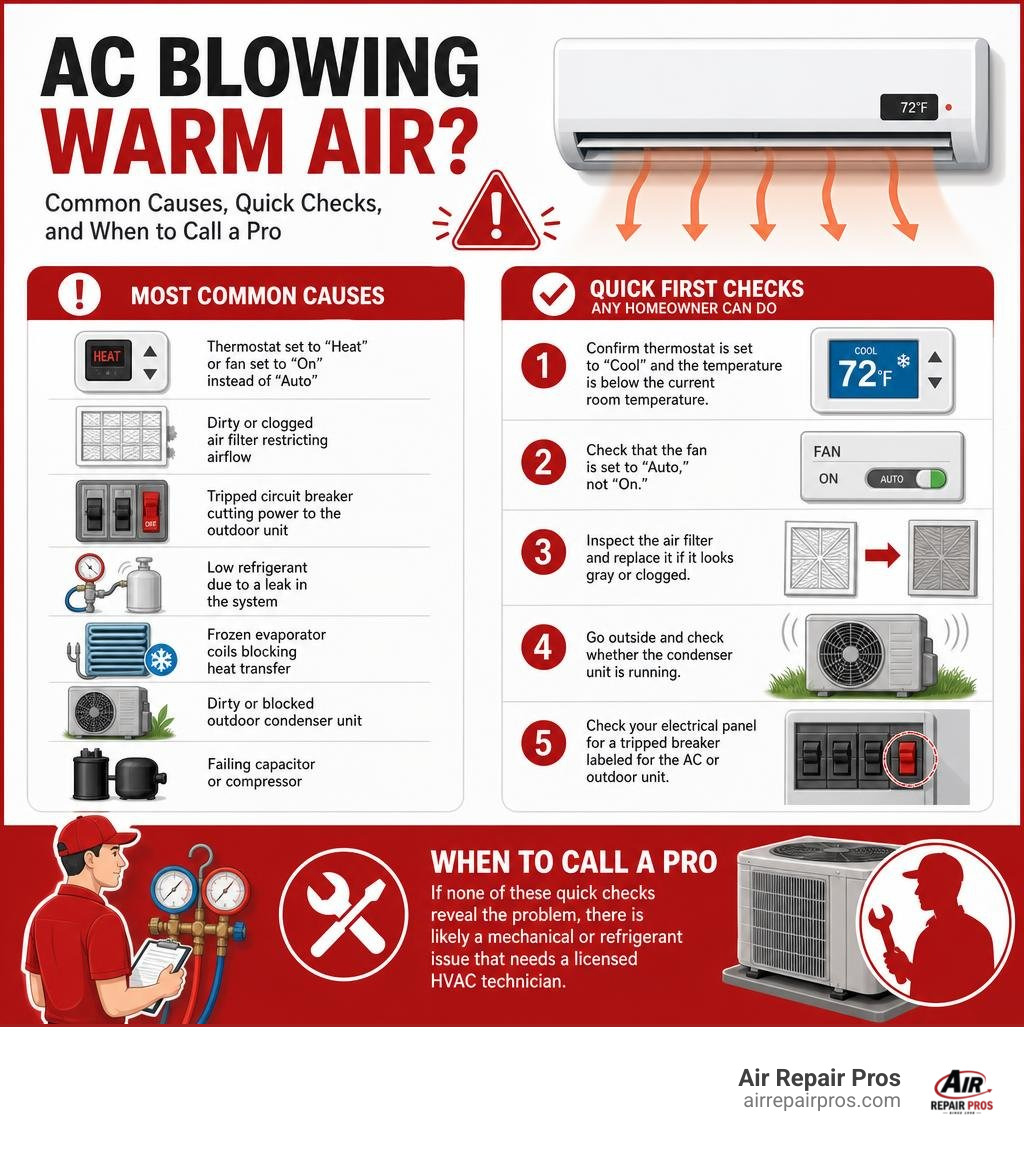
If your AC is blowing warm air, here are the most common reasons and what to check first:
Most Common Causes:
- Thermostat set to “Heat” or fan set to “On” instead of “Auto”
- Dirty or clogged air filter restricting airflow
- Tripped circuit breaker cutting power to the outdoor unit
- Low refrigerant due to a leak in the system
- Frozen evaporator coils blocking heat transfer
- Dirty or blocked outdoor condenser unit
- Failing capacitor or compressor
Quick First Checks Any Homeowner Can Do:
- Confirm thermostat is set to “Cool” and the temperature is below the current room temperature
- Check that the fan is set to “Auto,” not “On”
- Inspect the air filter and replace it if it looks gray or clogged
- Go outside and check whether the condenser unit is running
- Check your electrical panel for a tripped breaker labeled for the AC or outdoor unit
If none of these quick checks reveal the problem, there is likely a mechanical or refrigerant issue that needs a licensed HVAC technician.
There are few things more frustrating for a North Dallas, TX homeowner than walking into the house on a sweltering Texas afternoon, expecting a wave of cool air, and instead getting hit with warm, stale heat pouring out of the vents. When your AC runs but fails to cool, it is not just uncomfortable. In Texas summers, it can become a genuine health concern fast.
The good news is that AC blowing warm air is one of the most common HVAC complaints, and in many cases the cause is surprisingly simple. A misconfigured thermostat, a clogged filter, or a tripped breaker can all trigger this problem and can be resolved in minutes without any tools. Other causes, like a refrigerant leak or a failing compressor, require a certified technician to diagnose and fix safely.
This guide walks you through exactly what causes the problem, what you can safely check yourself, and when it is time to stop troubleshooting and call in a professional. Whether you are dealing with a central split system, a heat pump, or even a car AC that stopped cooling, you will find clear, practical answers here.
How Your Cooling System Works
To understand why your air conditioner might be blowing warm air, it helps to understand how the system cools your home. Many homeowners assume that an AC creates cold air from scratch. In reality, your AC works by removing heat from the indoor air and transferring it outside. This process is known as the refrigeration cycle.
The cycle relies on a specialized chemical called refrigerant, which changes states between liquid and gas to absorb and release heat. The process involves several key components working together:
- The Compressor: Often called the heart of the system, the compressor is located in the outdoor unit. It pumps the refrigerant through the system and pressurizes it, raising its temperature.
- The Condenser Coil: Also located in the outdoor unit, this coil allows the hot, pressurized refrigerant to release its heat into the outdoor air. A large fan blows across the condenser coil to speed up this heat transfer.
- The Expansion Valve: This component regulates the flow of refrigerant into the indoor unit, lowering its pressure and temperature rapidly.
- The Evaporator Coil: Located inside your home, usually near the blower fan, this coil becomes extremely cold. As warm indoor air is blown across the evaporator coil, the refrigerant absorbs the heat from the air. This cools the air, which is then distributed back into your home through your ductwork.
If any part of this cycle is interrupted, the heat transfer process breaks down. This results in the blower fan circulating unconditioned, warm indoor air. For a more detailed breakdown of these components and how they interact, you can consult professional HVAC resources. Additionally, you can learn more about general heating and cooling standards from the U.S. Department of Energy.
Common Causes of an AC Blowing Warm Air
When your cooling system malfunctions, several factors could be responsible. Troubleshooting starts with identifying whether the issue is electrical, mechanical, or related to airflow.
Some issues are minor and can be fixed in a few minutes, while others require professional intervention to prevent permanent damage to your system. Understanding the root causes is the first step toward getting your home comfortable again. For a deeper look at these issues, check out our guide on why your air conditioner is blowing warm air and explore our article on why your AC is blowing hot air for additional context.
The table below outlines the most common causes of an AC blowing warm air and the primary symptoms associated with each:
| Common Cause | Primary Symptoms | Difficulty Level to Check | Recommended Action |
|---|---|---|---|
| Incorrect Thermostat Settings | Fan runs constantly, air is room temperature, thermostat set to “Heat” or “On” | Very Easy | Adjust settings to “Cool” and “Auto” |
| Clogged Air Filter | Weak airflow, ice on indoor coils, system cycling on and off quickly | Easy | Replace the air filter immediately |
| Tripped Circuit Breaker | Indoor fan runs but outdoor unit is completely silent | Easy | Reset the breaker once in the electrical panel |
| Dirty Outdoor Condenser | AC runs but struggles to cool, outdoor unit is covered in dirt or leaves | Medium | Gently rinse the outdoor unit with a garden hose |
| Frozen Evaporator Coils | Ice visible on copper lines, weak airflow, warm air from vents | Medium | Turn off AC, run fan to thaw, replace filter |
| Refrigerant Leak | Hissing or bubbling noises, ice on lines, continuous running without cooling | Hard | Call a licensed HVAC technician |
| Failing Capacitor or Compressor | Loud buzzing or clicking from outdoor unit, fan runs but compressor does not start | Hard | Call a licensed HVAC technician |
Restricted Airflow and Dirty Air Filters
One of the most frequent causes of an AC blowing warm air is also the easiest to prevent: a dirty air filter. When an air filter becomes clogged with dust, pet dander, and debris, it restricts the volume of air flowing through the HVAC system.
This restriction has a cascading effect on your AC performance. Because there is not enough warm air passing over the cold evaporator coil, the refrigerant inside the coil cannot absorb enough heat. This causes the coil temperature to drop below freezing, turning moisture from the air into ice. Once the evaporator coil freezes over, it acts as a barrier, blocking airflow entirely and causing the system to blow warm air.
A dirty air filter can reduce your system’s efficiency and put immense strain on the blower motor. If your system is running but not cooling, checking the filter should always be your first step. Learn more about how restricted airflow impacts your home comfort in our article on AC not cooling.
Low Refrigerant Levels and System Leaks
Refrigerant is not a fuel that your AC consumes over time. It circulates in a closed loop, meaning your system should never run low under normal operating conditions. If your refrigerant levels are low, it is because you have a leak in the copper lines, the evaporator coil, or the condenser coil.
When a system loses refrigerant, its cooling capacity drops significantly. Without enough refrigerant to absorb heat from your indoor air, the air coming out of your supply vents will feel lukewarm or warm. Running an AC with low refrigerant levels can cause the evaporator coil to freeze and, worse, can lead to compressor burnout.
Because refrigerant is a hazardous substance regulated by the EPA, homeowners cannot legally or safely purchase or add refrigerant to their systems. Finding and repairing a refrigerant leak requires specialized tools, pressure gauges, and certified expertise.
Electrical Failures and Tripped Breakers
Your central AC system relies on two separate power supplies: one for the indoor air handler and blower fan, and another for the outdoor condenser unit. This separation is why your system can blow warm air even when it seems to be running.
If the circuit breaker for your outdoor unit trips, the indoor fan will continue to run, drawing in warm indoor air and circulating it through the vents without cooling it. The outdoor unit, which houses the compressor and condenser fan, will remain completely idle.
Other common electrical culprits include a failed capacitor or a bad contactor. The capacitor acts like a large battery that gives the compressor and outdoor fan the electrical boost they need to start up. If the capacitor fails, you may hear a loud buzzing noise from the outdoor unit, but the compressor will fail to start, resulting in warm air indoors. If your system is completely silent, read our troubleshooting tips for an air conditioner not turning on.
Step-by-Step Homeowner Troubleshooting Guide
Before you pick up the phone to call for service, there are several safe, simple steps you can take to troubleshoot your system. Many warm-air issues are caused by minor oversights that do not require professional repair. Following a systematic approach can save you time and money. For a comprehensive overview of DIY fixes, read our guide on how to fix your AC cooling problems.
Safe DIY Checks for an AC Blowing Warm Air
Always prioritize safety when inspecting your HVAC system. Turn off the power at the thermostat or the main electrical panel before performing any physical inspections of the equipment.
- Verify Thermostat Settings: Ensure the thermostat is set to “Cool” and the temperature setting is at least 5 degrees below the current indoor room temperature. Additionally, check the fan setting. If the fan is set to “On,” the blower will run continuously even when the cooling cycle is off, circulating unconditioned air. Switch the fan setting to “Auto” so it only runs when the system is actively cooling.
- Inspect the Air Filter: Turn off your AC and slide out the air filter. Hold it up to a light source. If you cannot see light passing through the filter, it is clogged and needs to be replaced immediately.
- Check the Outdoor Unit: Walk outside and inspect the condenser unit. Ensure there is at least two feet of clear space around the unit. Clear away any tall grass, weeds, leaves, or debris that might be blocking airflow. If the condenser coils are coated in dirt or lawn clippings, turn off the power and gently rinse the coils with a garden hose, spraying from the top down. Never use a pressure washer, as this can bend the delicate aluminum fins.
- Check the Circuit Breaker: Locate your home’s main electrical panel and look for the breakers labeled for your AC or outdoor condenser. If a breaker has tripped, it will be positioned between the “On” and “Off” settings. Flip it completely to “Off” first, then back to “On.” If the breaker trips again immediately, do not attempt to reset it a second time, as this indicates a serious electrical fault.
When to Avoid DIY and Call a Professional
While basic cleaning and setting adjustments are perfectly safe for homeowners, complex mechanical and electrical tasks should always be left to certified professionals. Attempting to service these components yourself can result in severe electrical shock, system damage, or voided warranties.
You should stop troubleshooting and call a professional licensed technician if you experience any of the following:
- Suspected Refrigerant Leak: If you hear hissing or bubbling noises near your indoor or outdoor units, or if you see ice buildup on the copper refrigerant lines, you likely have a leak.
- Electrical Component Failures: If your outdoor unit is buzzing loudly but the fan or compressor will not start, the capacitor or contactor likely needs replacement.
- Repeatedly Tripping Breakers: A breaker that trips repeatedly is a safety mechanism protecting your home from an electrical fire. This often points to a short circuit or a compressor that is drawing too much electrical current.
- Compressor Issues: If the outdoor fan is spinning but the compressor is not running, or if the unit makes grinding, rattling, or clanking noises when starting, the compressor may be failing.
Home AC vs. Car AC Blowing Warm Air
While both residential and automotive air conditioners operate on the same scientific principles of heat transfer and refrigeration, their designs, components, and common failure points differ significantly. Understanding these differences can help you diagnose issues correctly, depending on whether you are relaxing in your living room or driving down the highway.
Key Differences in System Design
Residential cooling systems are large, stationary split systems designed to condition thousands of square feet. They use high-voltage electrical connections, large copper lines, and refrigerants like R-410A. The outdoor unit is exposed to weather but remains stationary, meaning mechanical wear is primarily due to runtime.
Car AC systems, on the other hand, are compact and highly mobile. They operate in a harsh environment subject to constant vibration, engine heat, and road debris. Car systems traditionally used R-134a refrigerant, though newer models often use more environmentally friendly alternatives.
Because car AC systems are driven directly by the vehicle’s engine via a belt and pulley system, mechanical failures are often linked to engine operation.
Troubleshooting a Car AC Blowing Warm Air
If your vehicle’s air conditioner is blowing warm air, the troubleshooting steps differ from your home system:
- Check the Cabin Air Filter: Just like your home filter, a clogged cabin air filter will restrict airflow, causing weak cooling. It is usually located behind the glove compartment and should be replaced annually.
- Inspect the Compressor Clutch: With the engine running and the AC turned on high, look under the hood to see if the center of the AC compressor pulley is spinning. If the pulley spins but the center clutch does not engage, you may have an electrical issue, a bad clutch, or extremely low refrigerant.
- Clean the Radiator and Condenser: Road debris, bugs, and leaves can accumulate on the front of your car’s radiator and AC condenser, blocking airflow. Gently rinsing these areas can restore cooling performance.
- Inspect for Wiring Damage: Check the wiring connections leading to the compressor for signs of wear, corrosion, or damage from road debris or pests.
- Refrigerant Top-Off: While DIY refrigerant kits are available for cars, they are often a temporary fix. If your car is low on refrigerant, there is a leak in the system that should be professionally repaired to prevent damage to the compressor.
Preventive Maintenance to Avoid Future Cooling Failures
The best way to handle an AC blowing warm air is to prevent it from happening in the first place. Regular maintenance not only keeps your home comfortable during the hottest days of the year but also extends the overall lifespan of your equipment and keeps your energy bills manageable.
Regular maintenance, including changing your filters every one to three months, can help prevent many common AC failures. Professional tune-ups can also help your system run more efficiently and reveal small issues before they become major repair problems.

A comprehensive preventive maintenance routine should include both homeowner tasks and professional inspections:
- Homeowner Maintenance: Change your air filters regularly based on thickness (monthly for 1-inch filters, every two months for 2-inch filters). Keep the outdoor condenser clean and free of vegetation. Ensure indoor supply vents and return grilles are open and unobstructed by furniture or drapes.
- Professional Maintenance: Schedule a professional HVAC tune-up at least once a year, ideally in the spring before the summer heat arrives. A certified technician will inspect electrical connections, measure refrigerant levels, clean the evaporator and condenser coils, test safety controls, and identify minor issues before they turn into costly breakdowns. For homeowners in Collin County, scheduling regular air conditioning maintenance in McKinney, TX is the easiest way to ensure reliable cooling all summer long.
Frequently Asked Questions About AC Performance
Should I turn off my AC if it is blowing warm air?
Yes, you should turn off your AC immediately at the thermostat if it is blowing warm air. Continuing to run a malfunctioning system can cause severe, irreversible damage to expensive components like the compressor. For example, if the system is running low on refrigerant or has frozen coils, running it constantly can cause the compressor to overheat and burn out, leading to a much more costly repair.
How long does it take for an AC to blow cold air?
Under normal operating conditions, a standard central air conditioner should start blowing noticeably cool air from the vents within 10 to 15 minutes of starting up. If the system has been turned off for an extended period or if the house is extremely warm, it may take a little longer to lower the overall indoor humidity and temperature.
Can a dirty air filter cause my AC to blow warm air?
Yes, a dirty air filter is one of the most common causes of warm air output. When the filter is clogged, it restricts airflow across the indoor evaporator coil. Without sufficient airflow, the coil becomes too cold and freezes, blocking the passage of air and preventing the system from cooling your home.
Why is my AC blowing warm air but the outdoor fan is running?
If the outdoor fan is spinning but the system is blowing warm air, it usually means the compressor is not running. This can be caused by a failed start capacitor, a tripped circuit breaker specifically for the compressor, low refrigerant levels triggering a safety shut-off, or a failed compressor motor.
How do I know if my AC has a refrigerant leak?
Common signs of a refrigerant leak include a noticeable drop in cooling performance, warm air coming from the vents, hissing or bubbling noises near the indoor or outdoor units, and ice buildup on the copper refrigerant lines or the indoor evaporator coil.
Can I recharge my own home AC refrigerant?
No. Homeowners cannot legally purchase or add refrigerant to a residential AC system. Refrigerant handling is strictly regulated by the EPA and requires specialized training, certification, and equipment. Attempting to add refrigerant yourself can damage your system, void your manufacturer warranty, and violate federal environmental laws.
Why are my AC coils freezing up in the summer?
AC coils freeze up during the summer primarily due to restricted airflow or low refrigerant levels. Restricted airflow is typically caused by dirty air filters, blocked return vents, or a failing blower motor. Low refrigerant levels cause the temperature of the evaporator coil to drop below freezing, turning condensation into ice.
What does a loud buzzing noise from my outdoor unit mean?
A loud buzzing noise from the outdoor unit often indicates an electrical issue. This is commonly caused by a failing capacitor attempting to start the compressor, a stuck contactor, or loose electrical wiring. It can also indicate that the compressor motor is locked up and unable to start. Turn off the system immediately to prevent electrical damage.
How often should I change my home AC filter?
For standard 1-inch pleated filters, you should inspect them monthly and replace them every 1 to 3 months. If you have pets, suffer from allergies, or live in a dusty environment, you may need to change them more frequently. Thicker media filters, such as 4-inch or 5-inch filters, can often last longer, depending on the system and household conditions.
When should I call a professional for an AC blowing warm air?
You should call a professional if you have performed basic checks like thermostat settings, air filter, and circuit breaker, and the system still blows warm air. You should also call a technician immediately if you suspect a refrigerant leak, hear unusual noises like grinding or loud buzzing, or if your system repeatedly trips the circuit breaker.
Conclusion
Dealing with an AC blowing warm air during a hot Texas summer is an emergency that requires prompt attention. While simple issues like an incorrect thermostat setting or a dirty air filter can be resolved quickly by homeowners, complex mechanical, electrical, and refrigerant problems require the expertise of certified professionals.
For homeowners in Frisco, TX, McKinney, TX, Plano, TX, Little Elm, TX, and Allen, TX, Air Repair Pros has been the trusted name in home comfort since 1998. Our certified technicians arrive in fully stocked trucks carrying the parts needed for many one-trip services, helping our team resolve cooling issues quickly and efficiently. Whether you need emergency 24/7 assistance or want to schedule seasonal maintenance, our team is ready to restore your peace of mind and keep your home cool and comfortable.
If you are experiencing cooling issues, do not wait for the heat to take over your home. Contact our professional AC repair technicians today for help with warm air, weak airflow, or cooling system concerns throughout North Dallas.