
Establishing Your Ideal AC Filter Change Schedule
As a direct rule of thumb, an ideal AC filter change schedule requires replacing standard 1-inch pleated filters every 30 to 90 days, 1-inch flat fiberglass panels every 30 days, and thick 4-inch media filters every 6 to 9 months. Homes with pets, family members with respiratory sensitivities, or high summer cooling usage across North Texas should replace 1-inch filters every 30 to 45 days. Tailoring this replacement timeline to your household’s specific occupancy, filter thickness, and daily AC runtime protects your cooling equipment and ensures healthy indoor air quality throughout the year.
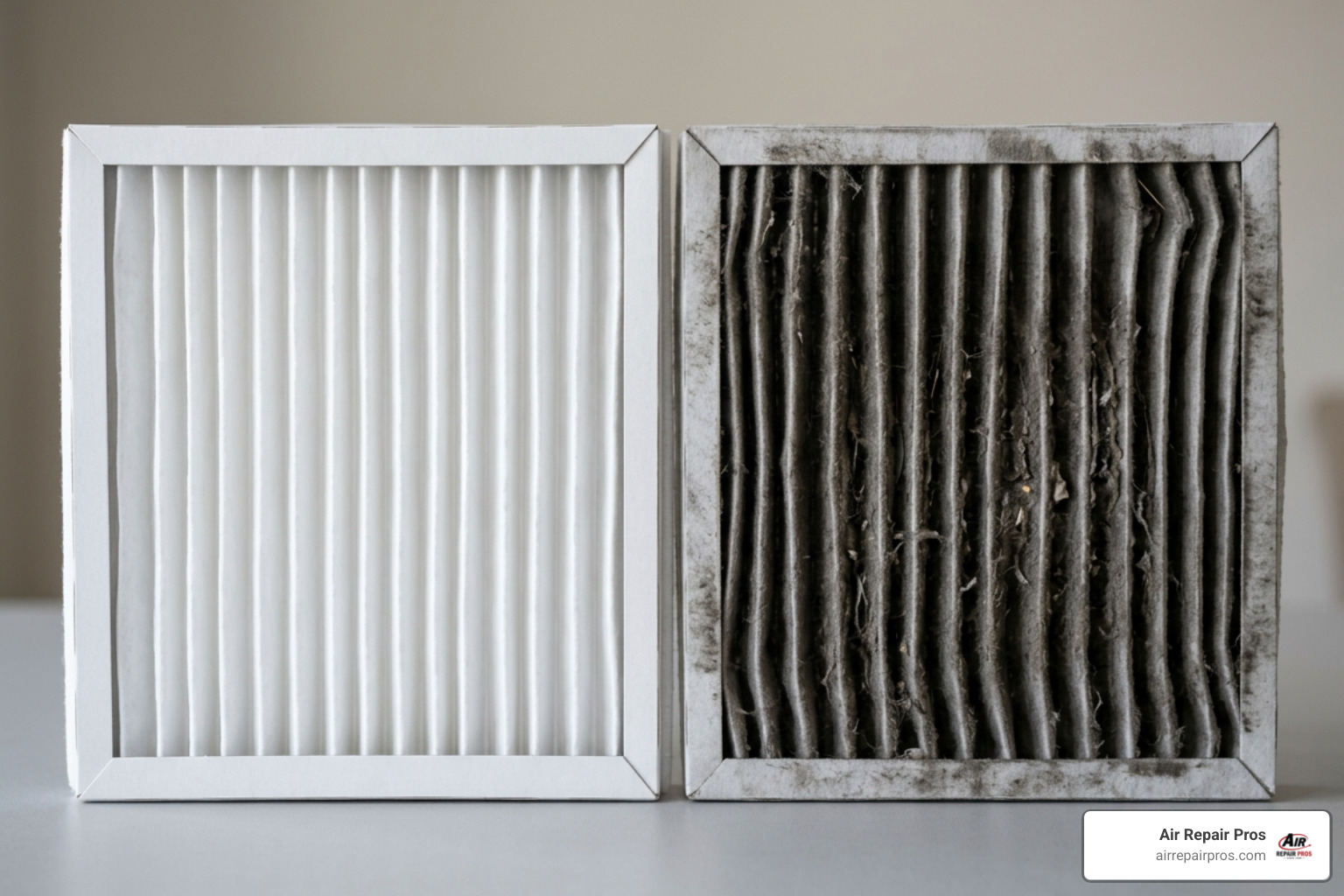
When you neglect your system, the damaging consequences of dirty air filters quickly compound. A restricted filter forces the system blower motor to pull against heavy resistance, driving up monthly utility bills and causing uneven temperatures across living spaces. In busy households across North Texas, particulate matter accumulates faster than expected, making routine visual inspections essential to preventing costly mechanical breakdowns.
| Household Profile | Filter Type and Depth | Recommended Change Interval |
|---|---|---|
| Single occupant, no pets, low dust | 1-inch Pleated (MERV 8) | 90 days |
| Average family home, no pets | 1-inch Pleated (MERV 8 to 11) | 60 to 90 days |
| Home with one shedding dog or cat | 1-inch Pleated (MERV 8 to 11) | 45 to 60 days |
| Multiple pets or family members with allergies | 1-inch High-Efficiency Pleated | 30 to 45 days |
| Active household during peak summer | 1-inch Flat Fiberglass | 30 days |
| Average home with dedicated media cabinet | 4-inch Deep Pleated Media | 6 to 9 months |
| High-occupancy home with pets and media cabinet | 4-inch Deep Pleated Media | 3 to 6 months |
Recommended Replacement Timelines by Filter Type
Different filter materials offer distinct functional lifespans based on their total surface area and media density. Flat fiberglass panels serve primarily as mechanical equipment protectors rather than fine air purifiers, capturing only large debris before quickly becoming saturated. Because their loose spun glass fibers offer minimal trapping area, these economical panels require replacement every 30 days without exception to prevent dirt from migrating directly onto delicate system components.
Standard 1-inch pleated filters use folded synthetic fabrics to multiply surface area, reliably capturing dust, lint, and pollen for 60 to 90 days under moderate operating conditions. High-efficiency pleated units capture significantly smaller particulates, meaning they collect debris rapidly and often need replacement closer to the 45-day to 60-day mark. For whole-home media filtration setups, 4-inch or 5-inch thick cartridges feature substantially more surface area than thin 1-inch options. These deep-pleated designs can operate effectively for 6 to 12 months, although quarterly inspections remain crucial to verify that heavy cooling runtime has not created premature airflow resistance across the media.
How Pets and Allergies Impact Your AC Filter Change Schedule
Pets bring joy into the home, but shedding fur and microscopic dander significantly increase the particulate load circulating through your return ductwork. Dander particles remain airborne for extended periods before settling into the filter fibers, filling the porous gaps that allow air to move freely. A single shedding dog or indoor cat can cut a filter’s effective operational lifespan by nearly half, while multiple pets create a continuous stream of organic debris that requires strict 30-day replacement intervals.
For household members dealing with respiratory sensitivities, sticking to strict replacement routines is critical. Pollen, dust mite droppings, mold spores, and microscopic allergens trigger inflammation when cycled continuously through living areas by a dirty HVAC system. Implementing dedicated allergy and asthma filtration solutions alongside a 30-day to 45-day replacement cadence keeps indoor air crisp, clean, and breathable throughout every season.
Seasonal Demands on Your AC Filter Change Schedule
The demanding climate across Texas creates extreme seasonal swings in cooling usage. During blazing summer months in communities like Frisco, TX, and Plano, TX, residential cooling systems operate for thousands of hours to maintain indoor comfort against persistent triple-digit heat. This continuous operation pulls massive volumes of indoor air through the filtration media daily, accelerating dust buildup and requiring homeowners to check filter conditions every few weeks.
Seasonal pollen blooms also demand proactive filter management. During spring, heavy oak, cedar, and ragweed pollen alongside agricultural dust infiltrate living spaces whenever exterior doors open. Understanding why spring filtration demands in North Texas require extra diligence helps homeowners stay ahead of sudden airflow restrictions. In winter, closed windows keep ambient dust, pet hair, and cooking residues trapped inside living areas, maintaining a continuous demand on your return air filtration system even when heating demands vary.
Types of AC Filters and Understanding MERV Ratings
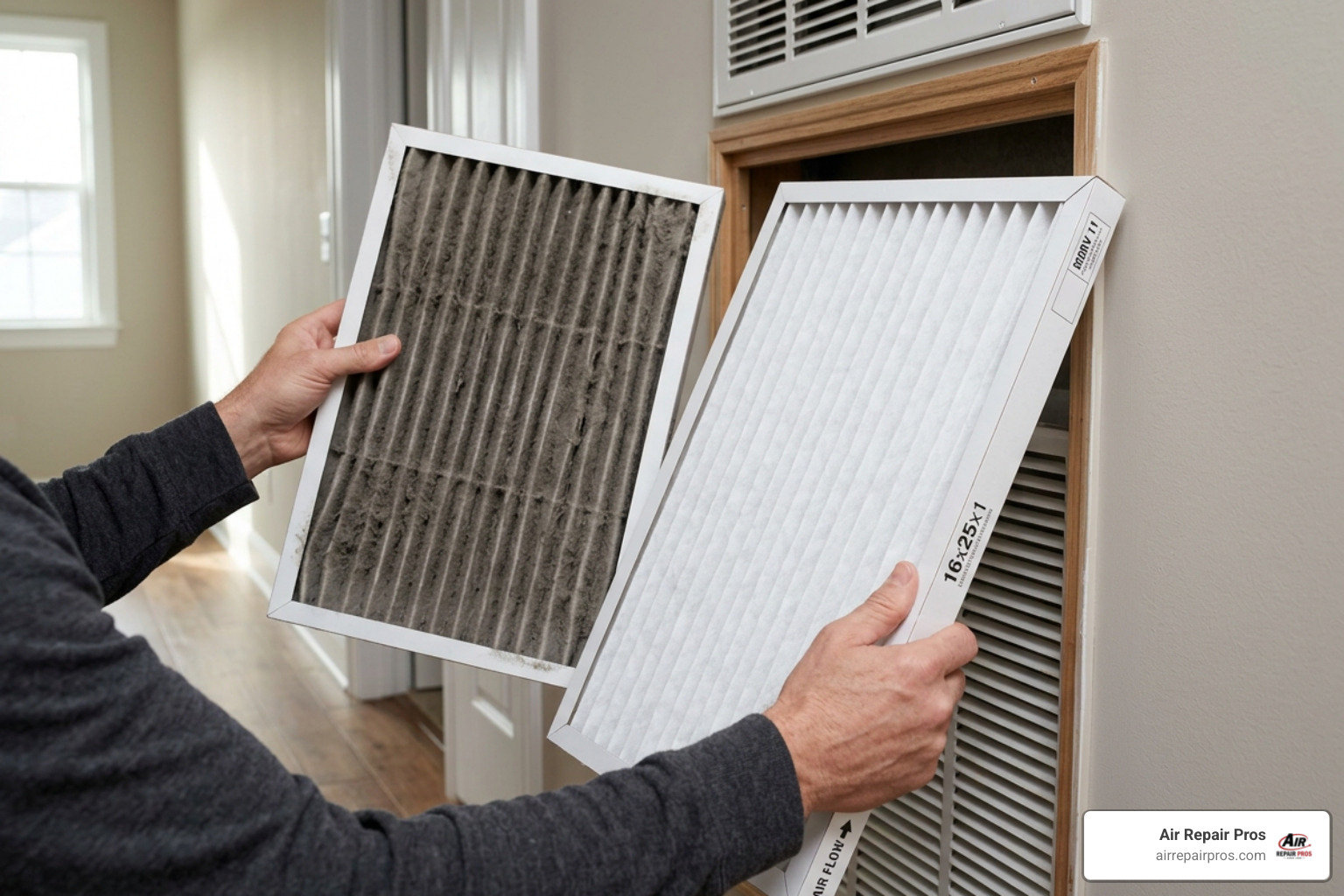
Choosing the correct air filter requires balancing indoor air purification with adequate airflow. Every HVAC system relies on balanced static pressure to circulate cooled air properly throughout your ductwork. Installing a filter with excessive media density can choke the system blower motor, while an overly porous filter permits fine dust to coat internal cooling coils, reducing heat transfer efficiency and promoting biological growth.
Comparing Fiberglass, Pleated, and Media Filters
Air filters fall into several distinct categories based on construction materials, longevity, and particle capture capabilities:
- Fiberglass Flat Panels: The most basic style available, constructed from layered spun glass encased in a lightweight cardboard frame. They stop large lint and hair from entering the air handler but let fine dust, pollen, and dander pass through easily, making them poor choices for indoor air quality.
- Pleated Synthetic Filters: Built using folded cotton or polyester blends, these filters provide substantially greater surface area within standard 1-inch to 2-inch frames. The accordion pleats capture mid-sized and fine allergens effectively while maintaining manageable resistance to airflow.
- Deep Pleated Media Cartridges: Typically 4 to 5 inches thick, these heavy-duty filters fit into dedicated media cabinets located adjacent to the air handler. They capture fine particulate matter with minimal airflow restriction due to their expansive surface area, lasting several months longer than thin panels.
- Washable Electrostatic Filters: Featuring aluminum or plastic frames with self-charging electrostatic fibers, these reusable units can be rinsed with water and reinstalled once completely dry. However, improper drying can introduce moisture into ductwork.
- Whole-Home HEPA Filtration Systems: High-Efficiency Particulate Air systems capture extremely small particles down to 0.3 microns with exceptional efficiency. Because true HEPA filtration creates immense airflow resistance, it requires dedicated bypass fan equipment rather than standard residential filter slots.
Choosing the Right MERV Rating for Residential Airflow
The Minimum Efficiency Reporting Value (MERV) rating system was developed by the American Society of Heating, Refrigerating and Air-Conditioning Engineers to measure how effectively filters capture airborne particles ranging from 0.3 to 10 microns in size. The scale ranges from MERV 1 up to MERV 16 for standard residential and light commercial equipment, with higher ratings indicating finer filtration capabilities.

Filters rated MERV 1 to 4 provide minimal particle capture, stopping only large debris like carpet fibers and insects. MERV 5 to 8 filters capture mold spores, dust mites, and pet dander, making them an excellent baseline for standard residential cooling systems. MERV 9 to 12 options provide enhanced air purification by trapping finer particulate matter like lead dust, vehicle emissions, and auto exhaust particles. MERV 13 to 16 filters capture bacteria, smoke particles, and microscopic allergens, offering hospital-grade air quality for vulnerable occupants.
Most modern residential cooling systems operate best with MERV 8 to MERV 11 filters. While upgrading to a MERV 13 filter provides exceptional particle capture for allergy sufferers, homeowners must ensure their ductwork and blower motors can handle the increased static pressure. Filters exceeding the design capacity of the HVAC system restrict critical airflow, causing component strain, higher energy bills, and declining cooling performance.
Signs of a Clogged Filter and the Risks of Neglect
Operating a cooling system with a neglected, dust-choked filter causes a chain reaction of mechanical failures. When air cannot move smoothly through the return register, the entire system struggles to transfer heat out of your home. Recognizing early physical warnings allows you to correct the issue before needing emergency AC repair during a severe summer heatwave in North Texas.
Clear Warning Signs Your Filter Needs Immediate Replacement
Your cooling system and living environment provide clear physical indications when air filtration media reaches full capacity:
- Weak Vent Airflow: Air exiting supply registers feels sluggish and weak, making distant rooms feel warm and stuffy despite normal thermostat settings.
- Elevated Electric Bills: The system runs significantly longer cooling cycles to reach thermostat setpoints, consuming excessive electricity and driving up utility expenses.
- Dust Rings Around Registers: Heavy gray dust deposits rapidly accumulate around supply vents, ceiling fans, baseboards, and living room furniture.
- Whistling Sounds at Return Grilles: High air velocity rushing through tiny unclogged gaps produces a distinct whistling, whining, or rattling noise at the return grille.
- Musty, Stale Odors: Trapped organic dust and moisture inside the return compartment produce persistent stale odors whenever the blower fan activates.
- The Visual Light Test: Removing the filter and holding it toward a bright lamp reveals no visible light transmission through the dense gray surface of the media.
How Dirty Filters Damage System Components and Spike Energy Bills
When airflow becomes restricted, thermal energy cannot reach the cold evaporator coil inside your indoor air handler. As the refrigerant inside the coil remains exceptionally cold without absorbing heat from moving air, condensed moisture freezes directly onto the metal fins. Over time, thick ice encases the coil entirely, blocking all air circulation.
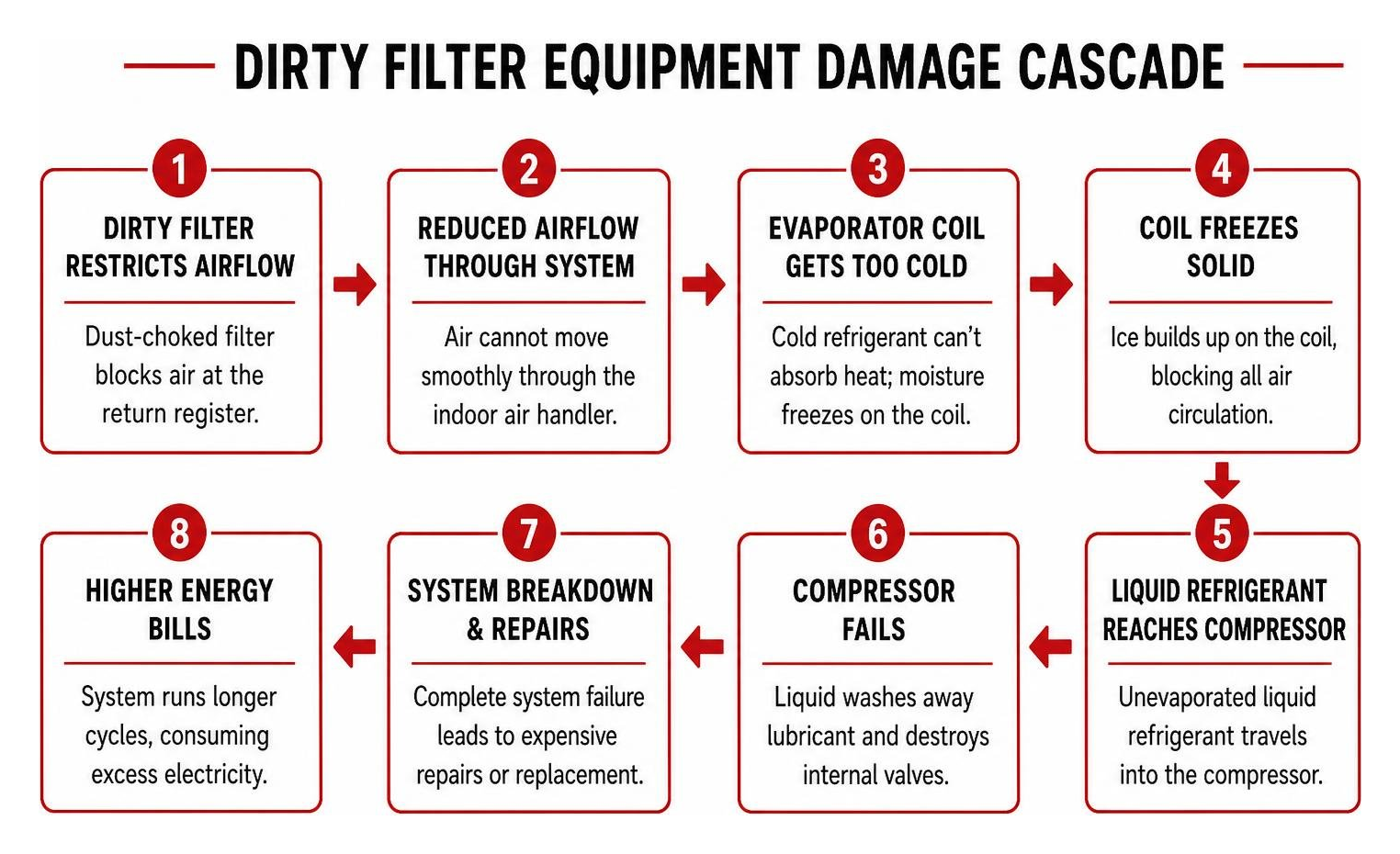
Coil freezing often causes unevaporated liquid refrigerant to travel backwards into the compressor pump. Because compressors are engineered solely to compress vapor, liquid refrigerant washes away internal lubricants and destroys mechanical valves, resulting in complete compressor failure and costly replacements.
Furthermore, the blower motor must work significantly harder against high static pressure, drawing higher electrical amperage and running at elevated internal temperatures. This thermal stress degrades motor windings, leading to premature motor failure. Fine particles bypassing a saturated filter also coat the blower wheel blades, creating an unbalance that wears out motor bearings rapidly.
To prevent expensive breakdowns and protect your equipment, pairing monthly filter management with a seasonal summer AC maintenance checklist helps all internal components remain spotless. Scheduling a comprehensive AC tune-up allows the certified technician team at Air Repair Pros to measure system static pressure, inspect electrical draw, and clean critical parts before minor airflow restrictions turn into major mechanical repairs.
How to Inspect, Size, and Properly Install an AC Filter
Performing regular filter replacements requires proper technique to maintain airtight performance and protect system components. Safety precautions must always come first when working around residential mechanical systems.
Safety Warning: Always power down your HVAC system at the thermostat or dedicated circuit breaker panel before opening return grilles or accessing air handler cabinets. Never reach into an operating air handler, as moving blower wheels and electrical components pose severe physical hazards. If you encounter damaged wiring, severe mold growth, or complex mechanical issues, contact a certified HVAC professional immediately.
Sizing and Directional Airflow Guidelines
Air filters feature two distinct sets of dimensions: nominal dimensions and actual dimensions. The nominal size printed in bold numbers on the cardboard frame (such as 20x25x1) represents a rounded measurement, while the actual dimensions measure roughly a quarter to half an inch smaller. Always purchase replacement filters based on exact nominal dimensions to prevent loose gaps that let unfiltered air bypass the media.
When inserting a fresh filter, inspect the outer cardboard frame for the printed airflow arrow. This arrow must always point in the exact direction that air moves through the ductwork:
- For Return Grille Locations: The arrow must point inward toward the wall cavity or ceiling duct opening.
- For Air Handler/Furnace Cabinets: The arrow must point directly toward the indoor blower unit and evaporator coil.
Installing a filter backwards causes the structural cardboard supports and wire backing to face the wrong direction. Under high suction pressure, an inverted filter can buckle and collapse into the blower housing, causing severe mechanical damage and allowing raw dust into the coil assembly.
Washable vs. Disposable Filter Maintenance
Washable electrostatic filters provide a reusable alternative to disposable media, but they demand careful maintenance. When cleaning a washable filter, take it outdoors and rinse it thoroughly using a low-pressure garden hose, spraying water in the opposite direction of normal airflow to flush out trapped particles.
Before reinstalling a washable filter into your HVAC system, ensure it dries completely in a clean area for several hours. Installing a damp filter introduces excess moisture directly into dark ductwork, creating an ideal breeding ground for mold spores, mildew, and airborne bacteria. While washable filters save on recurring purchases, high-efficiency disposable pleated filters consistently deliver superior allergen capture, lower maintenance hassle, and higher airflow consistency for homes in McKinney, TX, and Allen, TX.
Frequently Asked Questions About AC Filter Schedules
How often should I change my AC filter in Texas?
In Texas, standard 1-inch pleated filters should be checked monthly and replaced every 30 to 60 days during hot summer months. High system runtime and heavy seasonal dust load filters much faster than in cooler regions.
What happens if I don’t change my AC filter for a year?
Leaving a filter unchanged for a year severely restricts airflow, leading to frozen evaporator coils, blower motor burnout, spiked energy bills, and potential compressor destruction.
Can I vacuum and reuse my AC filter instead of buying a new one?
Vacuuming a standard disposable filter removes only loose surface dust while leaving embedded microscopic particles trapped in the fibers. Disposable filters must be replaced rather than cleaned.
What MERV rating is best for home air conditioning systems?
A MERV rating between 8 and 11 provides the best balance of allergen removal and optimal airflow for most residential cooling systems without placing strain on the blower motor.
Which direction should the airflow arrow point during filter installation?
The airflow arrow printed on the filter frame must always point in the direction of airflow, toward the air handler cabinet or indoor furnace.
Do thicker 4-inch media filters last longer than 1-inch filters?
Yes, 4-inch media filters feature significantly more surface area, allowing them to operate effectively for 6 to 9 months before needing replacement under normal household conditions.
Will running my AC fan continuously improve indoor air filtration?
Running the fan continuously circulates more air through the filter, but it increases household energy consumption and can reintroduce captured moisture back into the home during humid days.
What are the immediate signs that my AC filter is clogged?
Immediate warning signs include weak airflow from supply vents, persistent dust accumulation near return grilles, whistling sounds, extended cooling cycles, and visible dark gray discoloration across the filter media.
How do pets affect how often I need to replace my filter?
Pets shed fur and microscopic dander that quickly coat filtration fibers, typically requiring homeowners to replace 1-inch filters every 30 to 45 days to maintain proper airflow.
Can a dirty air filter cause my evaporator coils to freeze up?
Yes, a dirty filter restricts warm indoor airflow across the evaporator coil, causing refrigerant temperatures to drop below freezing and encasing the entire coil in thick ice.
Conclusion
Maintaining a consistent filter replacement routine protects your HVAC investment, preserves cooling efficiency, and ensures clean indoor air for your family all year long. By tailoring your replacement cadence to your home’s unique layout, pet activity, filter thickness, and seasonal demands, you can avoid unexpected breakdowns during scorching summer afternoons.
If you notice weak airflow, unusual sounds, or poor cooling performance even after inserting a fresh filter, contact our professional AC maintenance technicians. Proudly serving Frisco, TX, Little Elm, TX, and the surrounding North Texas communities, Air Repair Pros provides trusted HVAC solutions to keep your home comfortable in every season.